The Forward Deployed Engineer: A Recruiting Guide

What Is a Forward Deployed Engineer?

A forward deployed engineer (FDE) is a customer-facing technical professional who works closely with customers, business teams, or deployment sites. This doesn’t necessarily mean the person is always physically on-site, but it does mean they will be working directly with stakeholders, customers and users, and internal teams.

Their tasks include building, deploying, and improving complex software systems in real-world environments. In the world of AI, FDEs are counted on to get a proof of concept from the AI pilot stage to production.

Many companies are in the process of trying to adopt AI. But after they build a proof of concept or test their new generative AI tool, they struggle to move from pilot to production. Forward deployed engineers can be seen as truly multi-talented specialists as they must go beyond coding and debugging and have to act as a master of communication between multiple parties.

Forward deployed engineers specialize in working with the client or customer, ensuring that technical development aligns with customer expectations.
Forward deployed engineers can be seen as truly multi-talented specialists as they must go beyond coding and debugging and have to act as a master of communication between multiple parties.

What Does a Forward Deployed Engineer Do?

A forward deployed engineer main responsibilities include:

  • Designing Systems
  • Writing Production-Quality Code
  • Integrating APIs and Data Pipelines
  • Configuring Cloud Environments
  • Helping teams adopt new software or AI workflows
  • Debugging Post-Deployment Issues

After deployment, the FDE is still responsible for performing any live fixes and ensuring the system remains stable. This involves a process of incident response and triage and performance tuning before transitioning to a technical handoff where they train client engineers and create troubleshooting documents for the customer to use.

Even after they’ve fully handed off the system to the client, the FDE needs to abstract any useful custom integrations and other components from the product that can be made into reusable templates or internal SDKs. This part helps make the next similar project go faster.

You can see how FDEs are very hybrid in nature. Recruiting conversations may even make FDEs sound like three roles at once. If there was a Venn diagram of a software engineer, solutions architect, and an implementation lead, the forward deployed engineer is right in the middle of all three.

Why Forward Deployed Engineers Matter in AI

Forward deployed engineers matter in AI because many AI projects fail when they reach deployment and production. A model or platform may look impressive in a demo, but many organizations end up with a new AI system struggling to integrate with messy enterprise data, legacy systems, complex compliance requirements, and entrenched user workflows.

AI adoption is already widespread with McKinsey’s 2025 global AI survey finding that 88% of respondents’ organizations reported regular AI use in at least one business function. That’s a significant increase from 78% the year before.
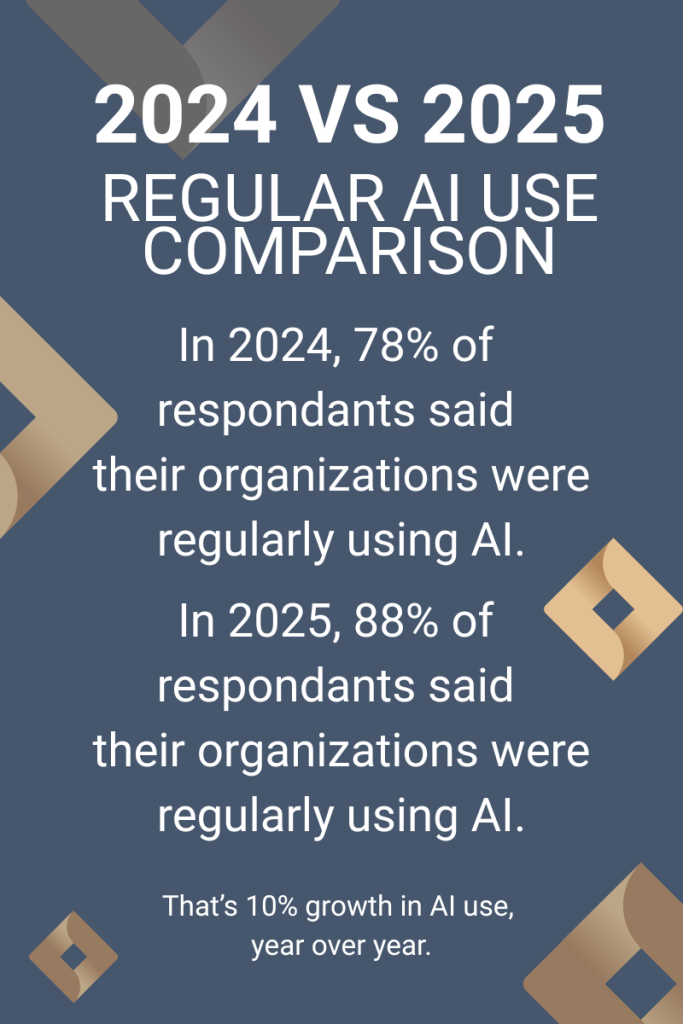
Comparison of 2024 and 2025 and the regular use of AI in organizations, in 2024 it was 78% of organizations that responded to a survey, in 2025 it went up to 88%. A forward deployed engineer will be essential for any of these companies and their AI initiatives.

But McKinsey also reported that nearly two-thirds of organizations have not yet begun scaling AI to an enterprise level, even though 62% of those respondents say their organizations are at least experimenting with AI agents. Those numbers show why we need experts like forward deployed engineers. Many companies are interested in AI, but they need people who can move projects beyond experimentation and use in a way that makes real gains for a business.

The demand for FDEs will keep growing, especially when looking at outcomes for GenAI projects. Gartner has reported that more than 50% of GenAI projects are abandoned after their proof-of-concept stages. This highlights how often organizations struggle to move AI initiatives towards production. Common failure points that Gartner noted include unclear business value, poor quality data, escalating costs, inadequate AI risk controls and AI governance concerns, and poor change management.

When Should a Company Hire a Forward Deployed Engineer?

A company should hire a forward deployed engineer when it needs hands-on technical talent to create custom product code for complex software or AI systems. In the context of AI, companies need FDEs to help move AI prototypes to stable production, build enterprise-level RAG (retrieval-augmented generation) architecture, and engineer complex agentic workflows that satisfy a company’s desire for something more like an autonomous agent.

This need is growing because companies are continuing to invest in AI while struggling to reach maturity. McKinsey’s workplace AI research found that 92% of companies plan to increase AI investments over the next three years. The problem is only 1% of leaders describe their organizations as mature in AI deployment. It will take the expertise of FDEs to remedy this problem.

A chart explaining how 92% of companies plan to boost their AI investments within the next 3 years, but the problem is that only 1% of those company leaders has reached maturity in AI deployment. Forward deployed engineers are necessary to fix this problem.

Common Hiring Triggers

Common hiring triggers include AI pilots that can’t make it to production, products with highly complex customer requirements, product teams needing feedback that’s from closer to the customer, or internal teams struggling to use new technologies in a way that directly contributes to business goals.

Signs Your AI Team Needs an FDE

Your AI team may need a forward deployed engineer if prototypes are not reaching production, users are not adopting your AI tools, data integrations are slowing progress, business teams cannot define requirements of the AI clearly, or your teams are struggling to evaluate AI outputs.

What Makes a Strong FDE Candidate?

A strong forward deployed engineer candidate has a unique hybrid skillset that bridges deep software engineering experience with a keen sense for client-facing business strategy.

In practice though, many strong FDE candidates might not even have “forward deployed engineer” in their resume. Recruiters should look for adjacent backgrounds and take a closer look at their skills, completed projects, and achievements.

The best FDE candidates should have stories to tell beyond their resume keywords. They can explain what it was they built, how they tackled constraints, what customer challenges they faced, and what they might’ve needed to do post-deployment to fix or optimize a product.

Provato Staffing recommends looking for candidates who have worked on systems that have gone live, handled post-deployment issues, worked across teams, led client-facing technical discussions, displayed good customer handling, and improved products based on user or customer feedback.

A forward deployed engineer knows how to communicate with customers, stakeholders, and technical teams, translating for each of them to maintain alignment on projects.
Many companies are interested in AI, but they need FDEs who can move projects beyond experimentation, translate between the customer and the developers, and enable AI projects to make real gains for a business.

Resume Keywords Recruiters Should Search For

These resume keywords are useful for recruiters in finding forward deployed engineers, especially accounting for how their hybrid nature touches the different roles mentioned here:

  • Forward deployed engineer
  • Forward deployed AI engineer
  • Solutions engineer
  • Customer engineer
  • Technical solutions engineer
  • Implementation engineer
  • Applied AI engineer
  • AI engineer
  • Platform engineer
  • Technical consultant
  • Enterprise implementation
  • Systems integration
  • API integration
  • RAG
  • LLM
  • GenAI
  • MLOps
  • AI agents
  • Workflow automation
  • Production deployment

Interview Questions to Ask FDE Candidates

When interviewing candidates for an FDE role, you should try to ask good probing questions to test for their hybrid nature such as the candidate’s comfort with chaos, how well they hold the line while maintaining client diplomacy, working under pressure, and their aptitude for discovering trends amongst customers.

Questions around a candidate’s comfort with chaos may include working with poorly defined customer problems or requirements, dealing with vague requests, and HOW did the candidate resolve this.

When asking about a candidate’s ability to maintain diplomacy, ask about how they handled demanding customers, how did they push back to keep a project within scope and on time, and look out for red flags.

Working under pressure is particularly great for FDEs as they are relied upon to help fix live deployment issues that can be costly for any company. Ask the candidate to give you a walkthrough of how they worked under this kind of pressure and ask them to give you the step-by-step explanation.

Skilled FDEs will also be able to notice trends happening amongst projects, like maybe several customers complaining about integration issues. This increased perception enables them to develop solutions that can make deployments more efficient or reliable and products.

How an IT Staffing Agency Can Help with Recruiting FDEs

A staffing agency that specializes in IT and engineering can help employers define this hybrid role clearly, determine adjacent talent, and screen for both engineering ability and customer-focused communication skills.

This is especially valuable because of how the FDE role is still emerging and taking shape. Many companies are still finding different ways that an FDE can help them.

For AI-related hiring, staffing agencies can also help evaluate whether candidates have real production experience or only prototype-level exposure. That difference matters as more organizations invest in AI but are struggling to scale it. The right staffing partner can help organizations and their hiring managers separate candidates who have experimented with AI from candidates who have deployed technical systems that users rely on.

A specialized IT recruiter like Provato Staffing can help clarify whether your organization needs a forward deployed engineer, solutions architect, AI engineer, implementation engineer, or a blended profile.


Internal Recruiting Teams Carry Risks in Tech Hiring

Organizations that rely solely on internal recruiting teams create measurable risk when hiring for specialized IT and engineering roles.

While a company’s HR team understands company culture, leadership dynamics, and internal approval processes, this doesn’t necessarily translate to the best outcomes when it comes to highly specialized roles in IT and engineering.

Filling these niche IT engineering roles requires a specialized technical evaluation. New hires must demonstrate proficiency in specific skills, tools, frameworks, and methodologies.

So, what might you miss by going exclusively internal versus tapping into a specialized IT recruiting partner?

Provato Staffing is a staffing team with backgrounds in IT and engineering. Our team reduces your risk by going beyond the job boards and tapping into passive market spaces to find and vet top talent that internal HR teams may overlook. After the Provato team vets and screens for the best matches, you just have to choose from a shortlist of qualified IT engineering candidates.

Relying solely on internal recruiting creates these five risks:

  • Technical screening gaps
  • Missed passive talent market
  • Extended time-to-hire
  • Compounding costs of mis-hires and re-hires
  • Asymmetric market intelligence
Using only internal recruiting teams may leave you blind to the candidate that's truly qualified, all because you may not have the proper information to identify them.

Why Are Niche IT Engineering Roles Outside of Standard Hiring?

IT Engineering roles stand outside of standard hiring because these highly specialized roles involve specific skills and knowledge that go beyond a generalist IT position. Instead, these niche roles require both deep experience and an evolving skillset that changes as tools, frameworks, and methodologies change.

For example, say you need a Kubernetes-certified DevOps engineer with experience in AWS architecture, or you need a coding expert who specializes in Python or Java—you can’t settle for less because a candidate missing any of those required competencies will lead to an expensive mis-hire.

Finding the right candidate for these IT engineering roles requires understanding candidate agility and the latest changes in the market and industry, but you might not have the necessary exposure to the technical market.

The amount of disconnect you might have from the technical market, no matter how big or small, can lead to what’s called a technical screening gap.

How Relying on Internal Recruiting Teams Creates a Technical Screening Gap

A technical screening gap refers to when you assess a resume for important keywords but miss out on context behind a candidate’s experience, tech stack, and past projects. This “trust versus verification” gap leads to forwarding candidates who look strong on paper but might not actually have the right technical skills for the specific job.

These “false positives” often occur because your internal HR team may overlook standardized technical evaluations for external candidates such as coding challenges or technical interviews. Just carrying out a trust-based screening with resume keyword matching and reference checks won’t help validate a candidate’s ability in IT engineering execution—it also increases the risk of mis-hires and their associated costs.

What’s Lost Without Verification?

Say you’re looking at a candidate resume that mentions AWS architecture, Kubernetes, Docker, Python, and CI/CD pipeline experience. Each of those “experiences” could have various meanings behind them.

For example, when a candidate says they’ve “used Kubernetes”, it pays to know whether it’s just a little deployment exposure or if they’ve learned cluster orchestration management from that experience.

But without verification, you miss out on much-needed context including:

  • Depth of implementation experience
  • Architectural decision-making capability
  • Code quality standards
  • Production-level troubleshooting experience
  • Security best practices

To perform verification-based screening, you’ll want to use structured evaluation mechanisms including timed coding assessments, architecture design exercises, technical deep-dive interviews, and GitHub/open-source contribution reviews.

Ignoring the external market also leads to the loss of a large passive talent pool that you could be tapping into.

Internal recruiting teams don't usually have the expertise to develop and maintain a passive talent pool of their own, leaving them unable to reach this qualified talent alone

What is the Passive Talent Market Most Companies Never Reach?

The passive talent market has highly qualified engineers who are not actively applying. But finding those skilled IT engineers often requires you to know where to look and engage in relationship-building to bring them over. Internal recruiting efforts tend to rely the most on inbound applications and visibility on a job board.

Passive IT/Engineering talent participate in technical communities and open-source ecosystems where they are most involved. On traditional recruitment platforms, they may have little presence, but in their communities, they’re actively applying and sharpening their skills in real-world projects.

Without access to these passive IT talent networks, internal recruiting competes only for active applicants, leaving stronger candidates off the table before internal teams can even engage them.

Knowing where to find your next hire is crucial, especially because of how quickly top talent can disappear from the market.

Why is Time-to-Hire a Strategic Business Risk?

Time-to-hire creates strategic business risk for IT engineering because it is a talent-scarce market with average hiring times continually rising. With how top talent often leaves the market with 10-14 days, a slow hiring process becomes a competitive liability to your hiring efforts.

An unfilled engineering role reduces productivity, increases team burnout, and delays revenue for you.

If you cannot find a suitable candidate fast, settling for just anyone isn’t the answer either. A mis-hire will already be costly, but so will the re-hire process be when you try again to find a more suitable candidate.

What is the Compounding Cost of Mis-Hires and Re-Hires?

The compounding cost of mis-hires and re-hires for specialized technical roles in IT engineering can extend from 50% to 200% of an employee’s annual salary when you take into account recruiting fees, training, and role complexity.

Your costs will compound from recruitment fees and onboarding, productivity loss and opportunity costs, turnover chain reactions, and burnout. Finally, there are also the long-term technical risks such as technical debt created by a mis-hire.

Even when you find the right candidate, internal teams may be behind on compensation, relying on historical salary ranges instead of what’s truly up-to-date. Asymmetry in your market intelligence can make it hard for your in-house recruiting to properly attract candidates that you deem qualified.

What is the Risk of Market Intelligence Asymmetry?

The risk of market intelligence asymmetry is losing a qualified candidate to a competitor because of a lack of data on compensation, candidate availability, candidate offer acceptance and counter-offer rates, and competitive hiring activity.

Internal HR teams rarely have full visibility into the market’s most updated salary figures or in-demand technologies, which can hurt decision-making. For example, offering the wrong compensation range can accidentally price yourself out of the competitive talent pools. This also exacerbates time-to-hire.

An external staffing agency like Provato Staffing can offer broader insights into the market because of their cross-market exposure to multiple companies, roles, and regions. This gives external agencies direct information into what technologies are in most demand, why candidates are accepting or denying offers, and even how job descriptions impact applicant pools.

Internal HR versus Specialized IT Staffing Agency

From what you’ve learned here, when hiring to fill specialized IT engineering roles, the differences between internal recruiting efforts and a specialized IT staffing partner directly affect risk, hiring speed, market intelligence, and technical validation capabilities.

Hiring Factor Internal HR Team Specialized IT Staffing Agency
Technical Screening Depth Resume keyword matching and general interviews Structured technical validation including coding assessments, architecture reviews, and deep-dive interviews
Trust vs. Verification Often trust-based evaluation of listed experience Verification-based screening of real-world execution and production capability
Access to Passive IT Talent Primarily inbound applicants and job board visibility Direct access to passive engineers in technical communities and open-source networks
Time-to-Hire Longer hiring cycles due to limited pipelines and market exposure Faster hiring through pre-qualified talent pools and active candidate engagement
Market Intelligence Limited real-time data on compensation trends and offer acceptance rates Cross-market salary data, counter-offer insights, and competitive hiring intelligence
Risk of Mis-Hire Higher risk due to screening gaps and limited technical validation Reduced risk through structured skill verification and domain expertise
Compounding Cost Exposure Greater exposure to 50–200% salary replacement costs Lower mis-hire exposure through validated candidate fit
Technology Trend Awareness May lag on emerging tools, frameworks, and certifications Ongoing exposure to in-demand technologies across multiple companies and regions
Hiring Factor
Technical Screening Depth
Internal HR Team
Resume keyword matching and general interviews
Specialized IT Staffing Agency
Structured technical validation including coding assessments, architecture reviews, and deep-dive interviews
Hiring Factor
Trust vs. Verification
Internal HR Team
Often trust-based evaluation of listed experience
Specialized IT Staffing Agency
Verification-based screening of real-world execution and production capability
Hiring Factor
Access to Passive IT Talent
Internal HR Team
Primarily inbound applicants and job board visibility
Specialized IT Staffing Agency
Direct access to passive engineers in technical communities and open-source networks
Hiring Factor
Time-to-Hire
Internal HR Team
Longer hiring cycles due to limited pipelines and market exposure
Specialized IT Staffing Agency
Faster hiring through pre-qualified talent pools and active candidate engagement
Hiring Factor
Market Intelligence
Internal HR Team
Limited real-time data on compensation trends and offer acceptance rates
Specialized IT Staffing Agency
Cross-market salary data, counter-offer insights, and competitive hiring intelligence
Hiring Factor
Risk of Mis-Hire
Internal HR Team
Higher risk due to screening gaps and limited technical validation
Specialized IT Staffing Agency
Reduced risk through structured skill verification and domain expertise
Hiring Factor
Compounding Cost Exposure
Internal HR Team
Greater exposure to 50–200% salary replacement costs
Specialized IT Staffing Agency
Lower mis-hire exposure through validated candidate fit
Hiring Factor
Technology Trend Awareness
Internal HR Team
May lag on emerging tools, frameworks, and certifications
Specialized IT Staffing Agency
Ongoing exposure to in-demand technologies across multiple companies and regions
  • Hiring for your niche IT engineering roles is not just a recruiting job, it’s about risk management.
  • Internal recruiting teams excel at cultural alignment and internal stakeholder communication, but there may be gaps in validating technical expertise in candidates.
  • Relying on just inbound applications limits your company and blocks access to the passive talent market.
  • Limited current market visibility leads to costly time-to-hire and compensation misalignment.
  • Consistent exposure to broader market data allows for faster and more accurate hiring for highly-specialized IT engineering roles.

Expand Your Hiring with a Specialized Tech Recruiting Firm

You can expand your hiring efforts and gain a clearer sense of the market with the expertise of Provato Staffing.

As a technical staffing partner that specializes in IT and engineering, Provato Staffing mitigates the technical hiring risk, delivering your next IT and engineering candidates by doing all the searching, screening, and vetting for you.

With our structured skill verification, real-time compensation intelligence, and direct access to passive IT talent, you can enjoy faster time-to-hire, validated candidate capabilities, and reduced mis-hire exposure.

The Benefits of Building a Diverse IT Team

Diversity is a core value for many organizations, and the IT team is no exception. A diverse IT team brings a variety of perspectives and experiences to the table, which can help you better meet the needs of your customers and create more innovative solutions.  Not only does having a diverse team bring fresh perspectives and new ideas to the table, but it can also be beneficial for the long-term success of any organization. But what are some of the specific benefits of building a diverse IT team? Let’s take a look at some of the ways in which diversity can improve your team’s performance.

A Wider Range of Experience and Skillsets

Having a diverse IT team means that you have access to a wider range of experience and skillsets. Whether it’s programming languages, hardware components, or software architecture, having employees from different backgrounds can help your whole team become more competent in their work. This allows for more efficient problem solving and quicker implementation of new technologies as well as strategies.

By diversifying your team members’ backgrounds, you can leverage different perspectives when facing a challenge

Harnessing Different Perspectives

IT teams are tasked with solving complex problems, often relying on creative solutions to get the job done. By diversifying your team members’ backgrounds, you can leverage different perspectives when facing a challenge. Each person will bring their own unique set of skills and experiences to the table, which can open up new ways of thinking about how to solve an issue. This kind of creative problem-solving can lead to more successful outcomes than if everyone on the team had the same background or experience level.

More Creative Solutions

Having people from varied backgrounds working together often leads to more creative solutions. Diversity encourages different perspectives on a problem, which can lead to better brainstorming sessions and innovative solutions that might not have been considered by an all-homogeneous group. Encouraging open dialogue between members with different backgrounds allows them to understand each other’s points of view and come up with creative solutions faster than if they were all coming from the same background.

Increased Innovation

In today’s technology-driven world, innovation is key for staying competitive in the market. By having employees from various backgrounds working together on projects, you increase your chances of success when it comes to developing new ideas or products that will appeal to a wider audience. People from different cultures often have unique insights into what might work well in certain markets due to their firsthand knowledge and understanding of those regions or communities—so having them involved in product creation could prove invaluable for any organization looking to stay ahead of the curve and innovate faster than its competitors.

Better Customer Service

When it comes to customer service, diversity plays an important role in creating a better experience for your customers. It’s natural for people to feel more comfortable talking to someone who they can relate to or has similar cultural or lifestyle experiences as them. Having a diverse team allows you to provide more tailored customer service that caters to each individual’s needs and preferences. Additionally, having employees from different cultures on board helps build trust with customers from other countries or regions—something that could be beneficial for businesses looking to expand internationally.

Having a diverse team allows you to provide more tailored customer service that caters to each individual’s needs and preferences

Conclusion:

Building a diverse IT team has many benefits including harnessing different perspectives when facing complex challenges, providing better customer service tailored specifically towards each individual customer’s needs, as well as increasing innovation through leveraging insights gained from employees with firsthand knowledge or experience with certain markets or communities around the world. All these benefits combine to create an environment where innovation flourishes and teams become more productive in their daily tasks. Investing in diversity is crucial for any organization looking for long-term success, so make sure you’re taking advantage of it!

Four Best Practices for Hiring Remote Workers

The last few years have redefined what companies are willing to offer in terms of remote work arrangements. And for good reason – it’s growing in popularity among employees. According to Flex Jobs, one survey found that 97% of respondents favored either to fully work remotely or hybrid work model. Other research shows that 70% of companies are looking to move to hiring remote workers, or at least a hybrid environment.

From both an employer and employee perspective, embracing remote workers is both an optimal and beneficial move. When a company makes the decision to hire remote employees when appropriate, it majorly increases employee retention, as you are giving them agency as a remote worker. You’re saying that their time and energy is valuable. With all of this in mind, the question for employers then becomes: “How do we improve our hiring process to better attract remote workers?”

Let’s take a closer look at some best practices you can use when recruiting and hiring remote workers. Keep these in mind and you’ll be sure to bolster your workforce with remote candidates who aren’t just highly skilled but also offer a fit for your corporate culture.

From both an employer and employee perspective, embracing remote workers is both an optimal and beneficial move.

Pre-Interview: Distinguish Between Your Needs and Wants in a Remote Worker

While there are many aspects of hiring remote workers that differ from hiring someone for an in-person role, some elements remain the same. Prior to interviewing the candidate, build your checklist of skills, qualities, and experiences you’d like your ideal candidate to have. Sort these qualities into two lists: “must-have” and “nice to have.” The must-have list is all things your candidate needs to perform the job functions, while the nice-to-have list will be valuable but not necessary.

You’d do this with a more traditional candidate, but the fact that you’re hiring remote workers might influence what falls into each bucket. For example, in either scenario, you’d want someone who’s a strong communicator. That means something different for a remote worker who isn’t within view of the team daily. It’s more important for them to have a mastery of videoconferencing or other communication software like Zoom or Google Meet. Digital communication is a vital component to remote work, and it will be crucial to ensure that your remote employees are familiar with these modes of digital communication and conferencing.

Sort these qualities into two lists: “must-have” and “nice to have.”

Emphasize Candidate Centricity During the Process

The concept of candidate centricity means you’re placing the emphasis on the candidate throughout the process, centering them as someone you’re actively recruiting. You’re certainly giving them opportunities to show they’re right for the role, but ultimately, centricity is about focusing on the benefits to them. You’ll communicate that you are trying to prove yourself to them as well.

For a remote worker, this means creating the right experience for them. For one, you need to overcommunicate during the process. Keep them updated on where they stand regarding what kind of skilled talent your organization is looking for, where they are in the talent pool and interview process, and what open positions you are considering them for. Both hiring remotely and working remotely require more communication, as face-to-face conversation is not as frequent. To hire remote workers, it is important to show them that remote work will not mean disconnectedness, and further, show them that your remote workforce is an efficient one. Failure to do so could result in them pursuing another opportunity.

For hiring remote employees, it is also important to consider having multiple interviews via zoom or teams. Hiring remotely means every conversation is via email or scheduled video chat, so it may be easier to stay focused on specific conversations or tasks at hand if calls or conversations are increased. If you have multiple interviews with a remote candidate, explain who they’ll be speaking with each time and why you’re doing more than one. With hiring remote workers, you won’t have the benefit of a face-to-face interview. Helping them understand why you want to have multiple rounds remotely will allow them to feel like they’re being recruited rather than vetted or qualified. You’re less likely to turn them off and frustrate them, and additionally, you’re introducing them to your company’s remote workplace.

Focus on creating a seamless experience for your remote candidate. Provide them with a clear job description and salary range. At each step of the process, be transparent about where they stand and what the next steps look like. It’s often said that a company will never treat a better candidate than they do during the recruitment process. While this may not always be the case, they’re certainly evaluating how you’re treating them here. It’s best to make your remote candidates feel wanted.

Focus on creating a seamless experience for your remote candidate.

Be Flexible and Interview Remotely

This one should go without saying, but you should obviously be prepared to interview your remote workers remotely. Ask them if they are comfortable with a videoconference over a standard phone call. This allows you to observe more of their mannerisms and body language, which can be helpful in assessing a candidate. You’ll be able to better gauge how confident they are in their responses.

If they decline a video interview and opt for a phone call, don’t hold this against them.  Communicating remotely isn’t the same as doing so in the office, so you’ll want to be flexible with how comfortable employees are showing their home to an employer they haven’t agreed to join yet.

You’ll also want to be flexible in when you can interview them. If your remote candidate has a job, you may have to interview them in the early morning, late afternoon, or early evening. You can’t expect a candidate with a 9-5 to be able to meet whenever is most convenient for you. Show some leniency when scheduling and accommodate a time that works with their calendar.

If your remote candidate has a job, you may have to interview them in the early morning, late afternoon, or early evening.

Be Open About Your Expectations for the Role

When considering hiring remote employees, determine the following: Is the job 100% remote? Are you offering a remote position for now until an eventual return to the office? Will it be a hybrid role?

Your answer to this question may vary. But whatever your expectations for your remote candidate, you need to make them 100% crystal clear as early as possible. If it is a fully remote role, say that. If it is not, say that as well. While it is beneficial for your company to offer a fully remote position to attract top candidates who may be located outside your metropolitan area, you may not be ready to do so. Or if the role will undoubtedly mean coming to the office every month, ask if the job seekers you are interviewing are open to monthly travel. Whatever your posture, the role should be well-defined for the candidate upfront, so the remote work is clear and the candidate knows exactly how flexible work arrangements are at your company.

If you don’t agree on where the candidate will be working in the short-term and long-term, it can lead to frustration and confusion later. The employee may feel as if they’re getting a job they didn’t sign up for. This can lead to the company losing out on a great employee due to a communication breakdown.

If the assumption is that the position is fully remote, state that during the screening process. If the remote candidate moves to the hiring stage, make sure to put in writing what their work arrangement will be.

The bottom line is that hiring remote workers is much like hiring someone who would sit in your office with a few important distinctions. By tailoring your staffing process to the remote worker’s unique situation, you’ll be able to identify the right people for your company and create a winning experience for the candidate that leads to more hires.

How to Write Job Ads that Attract Top Performers

For IT companies in the recruitment process, it can be challenging to attract the most talented candidates with a job ad. You have to identify an effective strategy to help consistently replenish your recruiting pipeline. On top of that, you have to be sure that you market the position in your job advertisement correctly so that you attract the right candidates with the necessary skills and experience needed to thrive in your IT staffing roles.

How do recruiters accomplish this? By posting a great job ad for each position. This is a critical component in the recruiting process, and it all comes down to the information you capture within the ad itself. What makes an effective job posting? A job posting that is as specific and descriptive as possible.

The information you include within your job ad is going to be the difference between identifying the right candidates and the wrong ones. By providing a detailed overview for job seekers, you increase the likelihood you end up with a group of qualified candidates in terms of skills, certifications, and knowledge during the hiring process.

Here are a few best practices on how to write IT job ads that get the best results, and attract top performers.

By providing a detailed overview for job seekers, you increase the likelihood you end up with a group of qualified candidates.

Be as Specific as Possible With Your Job Description

IT is a diverse and varied field. There are numerous roles with highly variant roles and responsibilities, all of which often share the same job title. The best method for finding the right people for each role is to create a list of all the job responsibilities and include them in your job ad.

Before you’ve even hired the candidate, you’re showing them that your company places a premium on crystal clear communication. You’re outlining the scope of the position prior to it starting. Remember that job seekers are also interviewing you, so being transparent establishes trust from the job posting.

For your potential candidates, this helps them know exactly what they’ll be doing. From the job title, job description, outline of their job responsibilities, they can then gauge whether they possess the recquired skills or if there are skill gaps. Once you’ve identified the right candidate and are looking to move forward, the job description serves as your candidate’s roadmap for success in the role.

Don’t forget other critical aspects of the job such as where the work is performed. Is this an on-site or a remote position? What is the salary range? Are there multiple spots or is there only one open position? Does it require a bachelor’s degree? The more information that you can provide in your job postings to give potential candidates a general idea of whether or not it is a good fit, the better.

Include the Necessary Skills

Beyond just describing the responsibilities of the role in the job description, you’ll also want to be clear on what skills are needed. For example, if you’re looking to hire a programmer with the job title “Full Stack Developer”, you’ll list the coding languages the candidate will need to know if they will be able to provide the solution your company is looking for. This sets the appropriate expectations in the job description and immediately transforms your job ad into a great job ad.

It also allows candidates with the needed skills to find your job when searching job postings and search engines. You’re more likely to identify a skill fit if you’ve got a comprehensive list of the IT skills needed to function in the role.

What happens if there are skills that would be great for your candidate to have, but aren’t required from day one? There is a strategy for addressing this: compile a list of skills you envision a high performer having in this role. Break these bullet points into two separate lists: “Must Have” and “Nice to Have.” If there are skills the candidate absolutely must possess to function within the role, include those on your “Must Have” list. If there are skills the candidate doesn’t necessarily require but would help separate them from the other job seekers, include those in that second list. Then identify the candidates who have all the “Must Haves” and as many of the “Nice to Haves” as possible, right in the job ad. You’re making a list of clear expectations, and also giving them an idea of what skills would boost their chances in landing the job.

The advantage of separating your IT skills this way is that you can attract candidates who are high performers and intelligent and have all of the required skills, but who may not have all the skills you’d love to see in an ideal candidate. By considering other elements (like attitude, background, other experience, and coachability), you can allow the individual to upskill in the role. Remember, you’re hiring a person, not a list of skills.

You’re making a list of clear expectations, and also giving them an idea of what skills would boost their chances in landing the job.

Include the Necessary Certifications

For many IT positions, certifications are an absolute requirement. Let’s take a cybersecurity analyst, for example. They have specific certifications that showcase their ability to detect and respond to various cyber threats.

If these are needed for the role, include them in the job ad. That increases the likelihood you’ll get candidates with the certifications they need to perform the role.

Some example certifications for various IT roles include:

  • Certified information security manager (CISM)
  • Certified information systems security professional (CISSP)
  • CompTIA
  • Certified ethical hacker (CEH)

Additionally, there are other certifications that aren’t limited to the IT sector but can often prove useful in an IT-focused role. For example, if you’re hiring a project manager for an IT helpdesk support team, you may want to hire a candidate with a Project Management Professional certification (PMP).

For many IT positions, certifications are an absolute requirement.

Include the Systems and Tools They’ll Need to Know

What kinds of software will the candidate use in this role? What is your company’s tool stack? Make sure to include them in the listing as well.

Remember your “Must Have” and “Nice to Have” list? Map your tool stack in your job ad over these lists as well. If you have a software platform that requires proficiency from day one, include this as a must-have. If you have software tools that can be more easily learned (i.e. project management or communication tools like Asana or Slack), then consider including them in the “Nice to Have” portion. Job seekers have different career paths and experiences, so giving them an idea of what relevant qualifications are needed vs desired is a good way to target top talent.

By identifying the tools you use in your job ad, you’ll attract the candidates you have experience with them. This decreases the amount of time it will take you to ramp up new hires after they join your organization.

By identifying the tools you use in your job ad, you’ll attract the candidates you have experience with them.

Sell Yourself

Job ads are so role-focused that often companies can forget they’re trying to impress the candidate just as much as the candidate is trying to impress them.

The U.S. Bureau of Labor Statistics forecasts that IT jobs will grow by a whopping 13% between 2020 and 2030. That means that top talent in IT roles are likely to have a wide variety of positions and companies to choose from. You’ll want to highlight your company’s unique value proposition in your job posting. When you’re writing your job ad, highlight the benefits to the candidate.

What differentiates you from your competitors? What elements of the employee experience do your current employees value the most? How competitive are your salary range and benefits offerings? Do you offer additional compensation such as bonuses or stock options?

Whatever advantages you have, include them in your job descriptions. This will stand out to IT professionals who want to know why they should work for you. Remember that the recruiting process is a two-way street, and when it comes to top talent, they’re vetting you as much as you’re vetting them.

If you’re looking for guidance on IT staffing, recruitment, or any other general IT support best practices, look no further. Provato Staffing can help. For more on how we can partner with you, contact us today!

What’s The Difference Between Hiring and Recruiting?

The difference between hiring and recruiting is that hiring mainly refers to the reactionary hiring that happens due to immediate and/or unexpected need, such as a sudden resignation, but recruiting refers to the long-term preparation of finding suitable candidates for both unforeseen events and when the team needs expansion. 

There is a thin line between the two, and the few firms that see it never go unrewarded. If you’re one of those who struggle to tell the difference or use the two terms interchangeably, you’re not alone. Did you hire or recruit the last employee at your firm? Let’s find out.

What Are the Definitions?

Recruitment and hiring are words that get thrown around with little thought to their actual meaning. When running your firm and keeping up with employment trends, the difference between hiring and recruiting should be obvious and intentional.

Recruitment: Recruitment involves the act of conducting research, analyzing, and searching for potential employees, also known as passive candidates, who may fit your company’s culture and needs. This is often done by specialized recruiters working for a staffing firm, and is performed before hiring needs come up.

Hiring: Hiring, on the other hand, involves engaging the services of a new employee, often in short order and due to immediate needs.

When you spend an afternoon browsing through resumes on LinkedIn that may fit your company culture with no intention to hire, you’re already starting on the path of recruiting and sourcing for passive candidates. You just don’t know it yet.

If you’d like to take a deeper look into how to source passive candidates to make recruiting truly effective, Provato Staffing has a whole guide and resources to help.

Here are some of the differences between hiring and recruitment.

Hiring Is Short Term, Recruitment Is Not

Hiring is a short-term process performed to meet the short-term or urgent needs of a firm. Recruitment is a long-term strategy meant to meet the future needs of your firm or company.

If a low-level staff member resigns today and needs to be quickly replaced, your firm will have to hire and move quickly. Subsequently, if there is a chance that your IT specialist may resign in five or ten years, you have to start recruiting. This means creating a pool or pipeline of qualified specialists to contact in case your IT specialist resigns sometime in the future.

Hiring is reactive, but recruitment is proactive.

There are a myriad of circumstances that may force a company to start hiring. They include the resignation of an employee, their promotion, unprecedented growth of a company, or their untimely demise. Whatever the circumstance, a firm should always be prepared to replace their employees within short notice.

There are a myriad of circumstances that may force a company to start hiring.

The Hiring Pool And The Recruitment Pool

We discussed the difference between hiring and recruiting. However, more specifically, there are significant differences between the hiring pool and the recruitment pool that impact your firm.

Hiring Pool: The hiring pool is usually made up of recently jobless or employed prospects that may or may not meet your firm’s needs and culture. To reach out to a hiring pool, a firm announces job vacancies, collects resumes, and eventually conducts interviews.

Recruitment Pool: Your recruitment pool, also referred to as a talent pipeline, is usually made up of a network of exceptionally qualified individuals that may already be employed, but can be open to the right opportunity. A well-built pipeline will consist of qualified employees who meet the requirements and qualifications of your firm.

Level Of Employee Specialization

Most of the time, the choice to hire or recruit for a firm depends on the circumstances and the timelines of the vacancy. One of these circumstances is the type of job vacancy.

Hiring & Low-Level Staff: Hiring is primarily used for low-level staff. Low-level staff vacancies do not require specialized skills making the employees easy to replace and onboard onto the firm. For example, if you’re onboarding a teenager to mow your lawn, you’ll probably hire.

Recruitment & High-Level Staff: Recruitment is mainly used to onboard high-level and specialized staff like in IT staff recruitment. Since these staff are highly specialized, replacing them at a moment’s notice may prove to be an uphill climb. This creates the need for having a ready pipeline of specialized employees and their contacts in case your firm needs to hire on short-term notice. Recruiting goes a long way in onboarding the best staff.

Why You Should Switch To Recruiting

Both recruiting and hiring come with their own set of benefits for a firm or company. However, an extensive comparison reveals that a firm will always be better off recruiting than hiring. Some of the benefits of recruiting include:

  • Easier scalability for your workforce
  • Continuous access to qualified talent
  • Reduced risk and cost in hiring
An extensive comparison reveals that a firm will always be better off recruiting than hiring.

Recruitment keeps your firm nimble and agile.

Where You Can Start

Recruiting requires building up your pipeline, maintaining it, and nurturing potential candidates. But the process takes time and resources, something not all internal HR teams have. With a recruitment agency like Provato Staffing, the burden of finding and creating talent pipelines is taken off your back. Provato Staffing has spent a significant part of the last few decades connecting companies with highly-specialized prospects. For more information, contact us today and let us be part of your story.

Top 10 Ways to Attract Engineering Talent

As technology continues to evolve, 

the need for top engineering talent is greater than ever. But how can you attract the best and brightest engineers to your company? The answer lies in creating an environment that supports their growth, offering competitive benefits, and providing opportunities for career advancement. But how do you make sure your company stands out from the rest? Here are Ten tips for attracting top engineering talent to your company.

1. Offer Competitive Salaries and Benefits

It’s no secret that top engineers are in high demand and can command a hefty salary. Offering competitive salaries and benefits not only entices them to work for your company but also helps retain them once they’re on board. Look into what other companies are offering in terms of salaries and benefits and make sure your packages match or exceed those offered elsewhere.

2. Invest in Professional Development Programs

When it comes to attracting top engineering talent, you want to offer something more than just a paycheck—you want to offer professional development programs that help them grow as professionals while they’re with your company. For example, consider offering targeted training programs or workshops designed to help engineers develop new skills or hone existing ones. Not only will this help attract top talent, but it will also improve employee morale and retention rates overall.

3. Leverage the Latest Technology

Engineers love technology and have a strong desire to work with the latest and greatest tool available.  Many will even choose the opportunity to use new technology over financial considerations.  Having outdated or legacy systems and tools will be a significant drawback when attempting to attract new talent.  Bite the bullet and upgrade your system and tools…it will be worth it!

Engineers love technology and have a strong desire to work with the latest and greatest tool available.

4. Provide a Defined Career Growth Path

Many organizations do not offer career advancement paths for technical resources. In these organizations you typically need to be promoted to a manager level to advance your salary and status within the company. Having a technical path for career advancement to go a long way in attracting top engineering talent. Often the top technical minds do not have the skills or desire to manage people, but that doesn’t mean that we shouldn’t recognize and reward them for the value that they bring to the company.

5. Provide Flexible Scheduling Options

Top engineers know their worth—and they don’t want to be tied down by traditional 9-5 scheduling options if there are other options available. Consider implementing flexible scheduling options such as remote work or flex time so that engineers can work when it works best for them without having to worry about being penalized for taking advantage of such options. This type of flexibility helps ensure that you attract the most talented staff possible without sacrificing productivity or results in the process.

Top engineers know their worth—and they don’t want to be tied down by traditional 9-5 scheduling options if there are other options available

6. Create a positive working environment

Employees want to work in an environment where they feel valued and respected. To create a positive working environment, ensure that your team has a healthy work-life balance with clear boundaries between work and personal life; provide regular feedback so employees feel appreciated; promote collaboration (as opposed to competition) among team members; offer training opportunities for upskilling; and recognize performance with rewards for those who go above and beyond.

7. Utilize Networking Events

Networking events are invaluable when it comes to recruiting top engineering talent because they provide an opportunity for potential employees to meet people who already work at your organization. They can get a feel for its culture before applying for any positions you may have open at the moment or in the future. And since most networking events are free or low-cost, they’re easy on the budget as well!

8. Leverage Social Media Platforms

Social media platforms like LinkedIn can be invaluable tools when it comes to recruiting top engineering talent—especially since many of these platforms allow users to search specifically for jobs by industry, location, or keyword.  This makes it easier than ever before for potential employees (and employers!) to find each other quickly and easily without having to invest too much time or effort into the process overall.

Social media platforms like LinkedIn can be invaluable tools when it comes to recruiting top engineering talent.

9. Leverage referral programs

Referral programs can be extremely effective when it comes to recruiting top engineering talent—so why not tap into the power of word-of-mouth marketing? Offer incentives such as discounts or gift cards for successful referrals made by current employees; this will not only help you find qualified candidates but also boost morale among existing staff members by showing them you appreciate their efforts in helping you find new team members!

10. Advertise open positions on job boards

Don’t forget about traditional methods of advertising open positions! Post job openings on your website and popular job boards like Indeed or Dice so potential candidates can easily find them—and make sure you include all relevant details about the position, so people know exactly what they’re applying for!

Post job openings on your website and popular job boards.

Attracting top engineering talent doesn’t have to be difficult—all it takes is some forethought and creativity on your part! Start today by implementing some (or all!) of these strategies—you never know who might be interested in joining your organization!