Why Tech Layoffs Don’t Mean Easy IT Hiring

You’ve likely heard about it at some point: the rise in AI and its adoption has disrupted the job market and led to a number of tech layoffs. But it doesn’t mean necessarily that IT hiring is easy now or that candidates are plentiful. In a July 2026 study by CompTIA, it was found that tech occupation employment in June 2026 had increased with active tech job postings reaching 600,000 for a second month in a row. And not only that, but tech unemployment has dropped to 2.9% as of July’s reporting.

To understand what’s driving this IT hiring demand, you’ll need to analyze the tech employment story from several angles: the layoffs, the demand for IT talent, the difficulty in finding qualified candidates, and how the transition from AI experimentation to implementation is driving the IT demand.

Do Tech Layoffs Mean It Is Easier to Hire IT Talent?

Not necessarily. Though tech layoffs occurred because of AI experimentation, companies are now strengthening their IT hiring across multiple industries.

When the tech layoffs began, it was because companies were under the impression that AI would be able to make up for the absence of human labor. While this means a large number of people have been removed from their positions, these layoffs only tell half the story of the tech labor market.

The other half is how companies are increasing their IT hiring again. Many organizations have discovered that AI experimentation is NOT the same as AI implementation. AI is a developing technology with immense potential, but it requires expertise from experienced IT-engineering specialists to properly use and train.

This has led to companies that tried to use AI to directly replace portions of their tech workforce, such as Ford Motor Company, to re-hire talent to keep operations running normally. According to Forbes in June 2026, what happened in Ford’s case was that “experienced engineers left before their knowledge could be encoded into Ford’s AI systems. Without that foundation, the automated tools amplified weak inputs rather than catching design flaws.”

As mentioned before, this isn’t just happening at Ford. Many companies are in the learning phases of how to properly implement AI as a truly productive tool. It is now a race to AI implementation, and that has become a driving force behind rising IT talent demand.

So, is the tech job market still competitive? The answer is yes, though it isn’t straightforward. And it’s not just confined to IT companies or vehicle manufacturing, it’s everywhere.

IT Talent Demand Now Extends Across Virtually Every Industry

IT talent demand is now rising across every industry such as:

  • Healthcare
  • Finance
  • Fintech
  • Manufacturing
  • Logistics
  • Retail
  • Ecommerce

Whether it’s your favorite grocery chain that needs IT talent for their logistics software or your bank that needs IT staffing to ensure their systems remain secure, these non-tech companies are hiring IT workers in greater numbers, especially for new AI initiatives.

The Rising IT Demand Isn’t Straightforward

The rising IT demand isn’t even across all industries as they continue to adjust to talent needs for technologies such as AI. According to the CompTIA study, employment in the tech sector decreased by around 900 jobs in June. But at the same time there was new hiring in both tech manufacturing and IT and software services companies. In all, the study found that actually tech employment in June had grown by 47,000 workers.

One insight to gain from this is that even if tech companies are shedding talent, that same talent is being picked up by non-tech industries that need IT support for their own projects such as harnessing AI.

And the demand is still great as ever. The study found that companies have listed over 280,000 new job postings for tech roles in June 2026.

But even with new job postings and higher demand for qualified IT talent, some organizations are finding themselves asking: “Why can’t I find the tech talent I need?”

Why is Tech Talent Hard to Find?

Tech talent is hard to find because tech unemployment has fallen to 2.9% as stated by the CompTIA study. That’s less than the national rate of 4.2%. It’s not just about finding an IT worker but finding the right one with the required skills and expertise. Most of this qualified talent is in the form of passive candidates, people who are already employed and not actively looking for a new job.

There is a whole process to sourcing passive candidates that goes beyond just IT job postings on a job site. But when internal HR teams don’t have the resources for it, there are IT-engineering staffing partners like Provato Staffing who are already sourcing these qualified candidates.

AI implementation is a significant driving force behind how demand has risen even amidst a year of tech layoffs. It’s part of why that tech talent quickly got absorbed by other organizations, and why job postings are left open for longer periods.

How is AI Implementation Changing IT Hiring?

AI implementation is changing IT hiring because more companies in other industries are now needing qualified tech workers associated with AI initiatives such as:

  • AI engineers
  • Data scientists
  • Software engineers
  • Cloud engineers
  • Automation engineers
  • Infrastructure specialists
  • Forward deployed engineers

Every organization that wants to get in on AI implementation is now clamoring for these IT professionals. Hiring managers will need to be ready to pursue potential talent with the right strategies and approaches.

How Can Companies Compete in IT Hiring?

For companies that want to compete for tech talent, hiring managers will need to adopt more proactive recruiting strategies, flexible hiring models, and stronger candidate evaluation mechanisms.

Proactive Recruiting

Proactive recruiting in IT is about creating a pipeline of passive candidates and using competitive techniques to draw those candidates to your organization when the time comes. It requires talent pipeline management, strong employer branding (especially when doing outreach to potential candidates), engaging with specialized sourcing platforms like GitHub and Stack Overflow, and building recruiter-to-candidate relationships.

Flexible Hiring Models

Flexible hiring models include hiring talent for capacities like contract, contract-to-hire, and project-based temporary positions along with your standard direct hiring.

Strong Candidate Evaluation

Thorough technical screenings will be key to stronger candidate evaluations and making sure a professional is qualified for your open roles. Some of these technical screenings may include system design deep dives, collaborative live coding sessions, and asynchronous skill assessments for further knowledge testing.

Proactive recruiting takes a lot of effort and requires to be maintained even after sourcing candidates. Many organizations don’t have the resources or the expertise in their HR teams to pull it off properly. When time is of the essence, there are specialized staffing agencies in IT and engineering who are already using proactive recruiting strategies to source and maintain their passive talent pipelines.

How Can a Specialized IT and Engineering Staffing Agency Help?

Staffing agencies that specialize in IT and engineering, like Provato Staffing, can help with their already-established pipelines of passive candidates. An IT-engineering staffing agency regularly maintains their networks of potential talent, taking the hard work off your internal HR team and making it faster and easier to get a qualified individual to the interview phase.

These staffing partners also offer candidates for various working capacities such as direct hire recruiting, contract staffing, and contract-to-hire staffing. The best ones perform technical screenings of their own to ensure a potential candidate is truly qualified for certain roles.

IT Hiring is Still Competitive, Regardless of Mixed Headlines

The mixed headlines about tech layoffs don’t reveal the true situation. IT talent demand remains competitive as industries continue to evolve in their adoption and use of AI technologies. But to get the right talent and not have your job postings sitting open for ages, it will be crucial for organizations to adapt in how they search for talent.

Provato Staffing is a specialized staffing partner that helps fill roles in IT and engineering. Whether it’s data scientists, AI specialists, or cloud engineers that your projects require, our staffers have pre-vetted and screened candidates who can help be the bridge between AI experimentation and AI implementation.

The Forward Deployed Engineer: A Recruiting Guide

What Is a Forward Deployed Engineer?

A forward deployed engineer (FDE) is a customer-facing technical professional who works closely with customers, business teams, or deployment sites. This doesn’t necessarily mean the person is always physically on-site, but it does mean they will be working directly with stakeholders, customers and users, and internal teams.

Their tasks include building, deploying, and improving complex software systems in real-world environments. In the world of AI, FDEs are counted on to get a proof of concept from the AI pilot stage to production.

Many companies are in the process of trying to adopt AI. But after they build a proof of concept or test their new generative AI tool, they struggle to move from pilot to production. Forward deployed engineers can be seen as truly multi-talented specialists as they must go beyond coding and debugging and have to act as a master of communication between multiple parties.

Forward deployed engineers specialize in working with the client or customer, ensuring that technical development aligns with customer expectations.
Forward deployed engineers can be seen as truly multi-talented specialists as they must go beyond coding and debugging and have to act as a master of communication between multiple parties.

What Does a Forward Deployed Engineer Do?

A forward deployed engineer main responsibilities include:

  • Designing Systems
  • Writing Production-Quality Code
  • Integrating APIs and Data Pipelines
  • Configuring Cloud Environments
  • Helping teams adopt new software or AI workflows
  • Debugging Post-Deployment Issues

After deployment, the FDE is still responsible for performing any live fixes and ensuring the system remains stable. This involves a process of incident response and triage and performance tuning before transitioning to a technical handoff where they train client engineers and create troubleshooting documents for the customer to use.

Even after they’ve fully handed off the system to the client, the FDE needs to abstract any useful custom integrations and other components from the product that can be made into reusable templates or internal SDKs. This part helps make the next similar project go faster.

You can see how FDEs are very hybrid in nature. Recruiting conversations may even make FDEs sound like three roles at once. If there was a Venn diagram of a software engineer, solutions architect, and an implementation lead, the forward deployed engineer is right in the middle of all three.

Why Forward Deployed Engineers Matter in AI

Forward deployed engineers matter in AI because many AI projects fail when they reach deployment and production. A model or platform may look impressive in a demo, but many organizations end up with a new AI system struggling to integrate with messy enterprise data, legacy systems, complex compliance requirements, and entrenched user workflows.

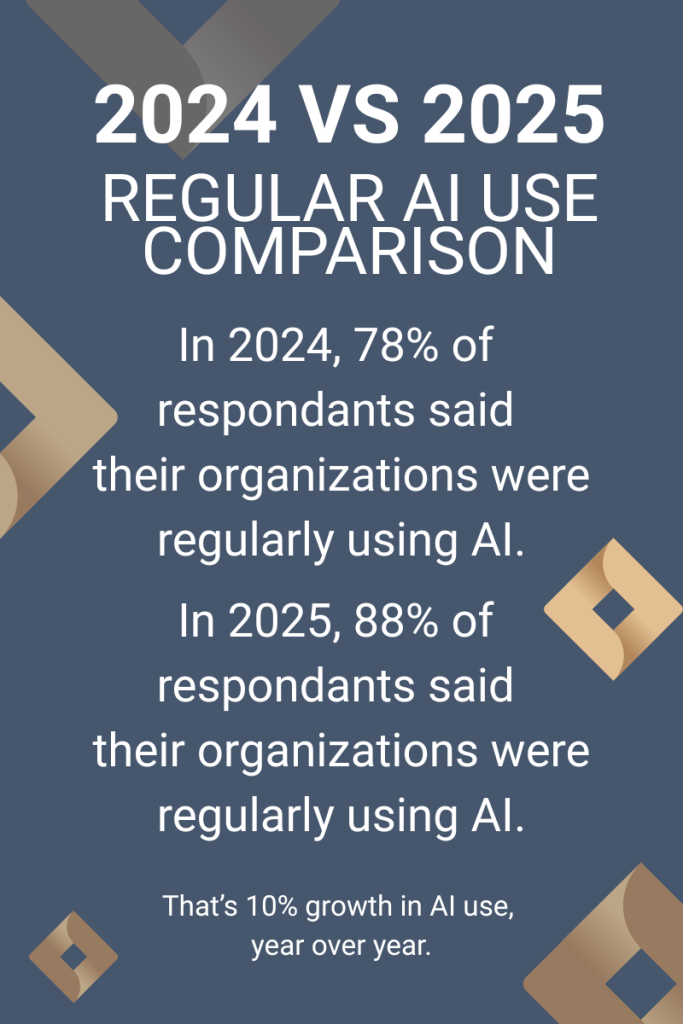
AI adoption is already widespread with McKinsey’s 2025 global AI survey finding that 88% of respondents’ organizations reported regular AI use in at least one business function. That’s a significant increase from 78% the year before.

Comparison of 2024 and 2025 and the regular use of AI in organizations, in 2024 it was 78% of organizations that responded to a survey, in 2025 it went up to 88%. A forward deployed engineer will be essential for any of these companies and their AI initiatives.

But McKinsey also reported that nearly two-thirds of organizations have not yet begun scaling AI to an enterprise level, even though 62% of those respondents say their organizations are at least experimenting with AI agents. Those numbers show why we need experts like forward deployed engineers. Many companies are interested in AI, but they need people who can move projects beyond experimentation and use in a way that makes real gains for a business.

The demand for FDEs will keep growing, especially when looking at outcomes for GenAI projects. Gartner has reported that more than 50% of GenAI projects are abandoned after their proof-of-concept stages. This highlights how often organizations struggle to move AI initiatives towards production. Common failure points that Gartner noted include unclear business value, poor quality data, escalating costs, inadequate AI risk controls and AI governance concerns, and poor change management.

When Should a Company Hire a Forward Deployed Engineer?

A company should hire a forward deployed engineer when it needs hands-on technical talent to create custom product code for complex software or AI systems. In the context of AI, companies need FDEs to help move AI prototypes to stable production, build enterprise-level RAG (retrieval-augmented generation) architecture, and engineer complex agentic workflows that satisfy a company’s desire for something more like an autonomous agent.

This need is growing because companies are continuing to invest in AI while struggling to reach maturity. McKinsey’s workplace AI research found that 92% of companies plan to increase AI investments over the next three years. The problem is only 1% of leaders describe their organizations as mature in AI deployment. It will take the expertise of FDEs to remedy this problem.

A chart explaining how 92% of companies plan to boost their AI investments within the next 3 years, but the problem is that only 1% of those company leaders has reached maturity in AI deployment. Forward deployed engineers are necessary to fix this problem.

Common Hiring Triggers

Common hiring triggers include AI pilots that can’t make it to production, products with highly complex customer requirements, product teams needing feedback that’s from closer to the customer, or internal teams struggling to use new technologies in a way that directly contributes to business goals.

Signs Your AI Team Needs an FDE

Your AI team may need a forward deployed engineer if prototypes are not reaching production, users are not adopting your AI tools, data integrations are slowing progress, business teams cannot define requirements of the AI clearly, or your teams are struggling to evaluate AI outputs.

What Makes a Strong FDE Candidate?

A strong forward deployed engineer candidate has a unique hybrid skillset that bridges deep software engineering experience with a keen sense for client-facing business strategy.

In practice though, many strong FDE candidates might not even have “forward deployed engineer” in their resume. Recruiters should look for adjacent backgrounds and take a closer look at their skills, completed projects, and achievements.

The best FDE candidates should have stories to tell beyond their resume keywords. They can explain what it was they built, how they tackled constraints, what customer challenges they faced, and what they might’ve needed to do post-deployment to fix or optimize a product.

Provato Staffing recommends looking for candidates who have worked on systems that have gone live, handled post-deployment issues, worked across teams, led client-facing technical discussions, displayed good customer handling, and improved products based on user or customer feedback.

A forward deployed engineer knows how to communicate with customers, stakeholders, and technical teams, translating for each of them to maintain alignment on projects.
Many companies are interested in AI, but they need FDEs who can move projects beyond experimentation, translate between the customer and the developers, and enable AI projects to make real gains for a business.

Resume Keywords Recruiters Should Search For

These resume keywords are useful for recruiters in finding forward deployed engineers, especially accounting for how their hybrid nature touches the different roles mentioned here:

  • Forward deployed engineer
  • Forward deployed AI engineer
  • Solutions engineer
  • Customer engineer
  • Technical solutions engineer
  • Implementation engineer
  • Applied AI engineer
  • AI engineer
  • Platform engineer
  • Technical consultant
  • Enterprise implementation
  • Systems integration
  • API integration
  • RAG
  • LLM
  • GenAI
  • MLOps
  • AI agents
  • Workflow automation
  • Production deployment

Interview Questions to Ask FDE Candidates

When interviewing candidates for an FDE role, you should try to ask good probing questions to test for their hybrid nature such as the candidate’s comfort with chaos, how well they hold the line while maintaining client diplomacy, working under pressure, and their aptitude for discovering trends amongst customers.

Questions around a candidate’s comfort with chaos may include working with poorly defined customer problems or requirements, dealing with vague requests, and HOW did the candidate resolve this.

When asking about a candidate’s ability to maintain diplomacy, ask about how they handled demanding customers, how did they push back to keep a project within scope and on time, and look out for red flags.

Working under pressure is particularly great for FDEs as they are relied upon to help fix live deployment issues that can be costly for any company. Ask the candidate to give you a walkthrough of how they worked under this kind of pressure and ask them to give you the step-by-step explanation.

Skilled FDEs will also be able to notice trends happening amongst projects, like maybe several customers complaining about integration issues. This increased perception enables them to develop solutions that can make deployments more efficient or reliable and products.

How an IT Staffing Agency Can Help with Recruiting FDEs

A staffing agency that specializes in IT and engineering can help employers define this hybrid role clearly, determine adjacent talent, and screen for both engineering ability and customer-focused communication skills.

This is especially valuable because of how the FDE role is still emerging and taking shape. Many companies are still finding different ways that an FDE can help them.

For AI-related hiring, staffing agencies can also help evaluate whether candidates have real production experience or only prototype-level exposure. That difference matters as more organizations invest in AI but are struggling to scale it. The right staffing partner can help organizations and their hiring managers separate candidates who have experimented with AI from candidates who have deployed technical systems that users rely on.

A specialized IT recruiter like Provato Staffing can help clarify whether your organization needs a forward deployed engineer, solutions architect, AI engineer, implementation engineer, or a blended profile.

Guide to Passive Candidate Sourcing in IT-Engineering

Many companies understand that passive candidate sourcing can be highly valuable in IT and engineering hiring. But the harder question is how to actually find and engage them. According to a 2026 review by National University, 46% of employers say, “attracting qualified candidates is their #1 challenge” and that also 52% of employees “are open to leaving their current role in 2026”. This suggests that a substantial share of employed talent across the country, including people in IT and engineering fields, might be open to a new role if given the right opportunity. But these numbers also suggest that companies are struggling right now to tap into this large source of passive talent.

Internal HR teams aren’t always equipped with the resources to start and nurture their own pipeline of passive candidates. This process takes time, effort, and a familiarity with the process to ensure the sourced talent remains engaged and successfully attracted to a new role.

That’s when an IT recruiter like Provato Staffing can provide expertise, guidance, and an already-established passive talent network that can seek out the skilled tech workers that your organization requires to fill your open roles.

Sourcing passive candidates requires more than just searching for a job title and sending a generic message to a currently-employed individual. IT-engineering recruiters need to understand the required skills, identify any adjacent titles, evaluate technical signals, choose the right sourcing channels, and track talented workers, and be able to repeat the process while nurturing any sourced talent.

This deep-dive guide of proven strategies will break down how to source passive candidates for IT and engineering positions, from knowing where to look and build your search criteria to knowing when an IT staffing partner can help expand your reach and quicken your passive recruitment.

Before you begin your search and find your first passive candidate, you need to know exactly what candidate qualities to look for.

What Is Passive Candidate Sourcing?

Passive candidate sourcing is the process of proactively identifying and engaging potential talent who are not actively applying to jobs but may be open to the right role should the opportunity arise.

In IT and engineering recruiting, these passive candidates could be software developers, AI specialists, cloud engineers, DevOps specialists, cybersecurity professionals, data engineers, systems administrators, electrical engineers, mechanical engineers, and other roles. But what makes them “passive” is that they are currently employed and may not be actively searching for their next job opportunity.

This means these talented individuals may not be on job boards where they’d be easier to find. Instead they may be happy in their current role, but they could still be open to a position if offered stronger compensation, better flexibility, more benefits, more technical ownership, clear career growth, or even just a more interesting project environment.

Definitions for Terms Often Found in Passive Candidate Sourcing

TermMeaning
Passive CandidateThese are candidates who are not actively applying but may consider the right role if approached the right way
Passive Candidate SourcingThis is the PROCESS of finding and engaging with already-employed individuals
Passive Talent PipelineThis is the proactively sourced and nurtured collection of qualified passive candidates that can be for current or future hiring needs

If you’d like, you can learn more here at Provato Staffing about what a passive candidate is and how they can bring you the best in IT and engineering talent.

The next step will be to understand how passive candidate sourcing actually works in a technical recruiting environment.

How Does Passive Candidate Sourcing Work in IT-Engineering Recruiting?

Passive candidate sourcing in IT-engineering recruiting works by having your recruiters analyze the role requirements and transform them into practical search criteria. This helps you pick out potentially qualified talent across multiple channels, determine a person’s technical fit, and engage those passive candidates with relevant, hyper-personalized outreach.

But before searching for your passive candidates, you will need to clearly establish:

  • What the candidate’s required skills are
  • What kind of seniority level they need to have (entry, mid-level manager, etc.)
  • What kinds of tools they should have expertise in
  • What platform experience they need
  • What the expected compensation range should be
  • Work location or work model preference
  • What your hiring timeline is to keep track

From there, your recruiting team can begin the process of passive candidate sourcing. But the process isn’t easy and requires a lot of effort, and there are challenges to be aware of.

What Are the Challenges in Passive Candidate Sourcing?

Passive candidate sourcing comes with challenges that require IT and engineering recruiters to depend on more than just keyword matching. Recruiters need to understand how different titles, skills, and experiences can connect to each other to create a professional who can complete your intended job role.

For example, say that your company is looking to hire a cloud engineer, or at least that’s your initial thought. But depending on the actual responsibilities, you might be able to consider DevOps engineer candidates, or other relevant talent.

The same applies to engineering roles. A manufacturing company hiring an electrical engineer may need someone with experience in PLC programming or controls systems. But that means they may want to also look at controls systems engineers, automation engineers, or even mechanical engineers in some cases.

The point is, the right candidate may not use the exact job title in the posting, but their experience and skills may be close enough that it should count in meeting the role’s goals and expectations!

With the above passive candidate sourcing workflow in mind, the next section breaks down this process into practical steps for tech recruiters to follow.

Depending on the actual responsibilities of a role, sometimes a passive candidate with a different job title may still fit.

How to Source Passive Candidates Step-By-Step

This step-by-step process to sourcing passive candidates will guide you on how to prepare for your search, how to conduct your candidate sourcing, and how to track your results and nurture the candidates you do find.

With a step-by-step process, your recruiters will stay focused, be able to evaluate talented individuals more consistently, and avoid wasting time on profiles that are unlikely to fit the role’s requirements.

The Step-By-Step Process for Sourcing Passive Candidates

StepActionTech Recruiting Example
1Clarify the roleConfirm what your candidate’s tech stack, seniority, work model, salary range, and must-have skills should be.
2Build a candidate personaIdentify likely and adjacent titles, industries, tools, skills, technical environments, and career paths.
3Create search criteriaSeparate required skills from preferred qualifications, what a candidate MUST HAVE versus what can be taught on the job.
4Choose sourcing channelsUse LinkedIn, GitHub, Kaggle, Stack Overflow, and other niche platforms and communities.
5Review technical signalsLook for a candidate’s past projects, their education and certifications earned, platform experience, and recent tool usage.
6Prioritize candidatesRank your discovered candidates by technical fit, geography and/or work location preference, seniority, and relevance to your open role.
7Send targeted outreachUse a brief but hyper-personalized message that’s tied to the candidate’s experiences, background, and their work.
8Follow up appropriatelyUse a respectful keep-warm cadence, but don’t overwhelm the candidate
9Track resultsFollow and measure response rate, positive replies, qualified screens, and if any candidates apply.
10Add future-fit candidates to the pipelineSegment candidates by skill set, role type, and timing. Continue to nurture those candidates to maintain the talent pipeline.

Before anything else can be done, the first step must be done right.

If the role intake is unclear, every sourcing decision after it becomes weaker. Recruiters need to know which requirements are non-negotiable and which ones can flex for the right candidate.

How Must-Have and Nice-to-Have Job Requirements Impact Your Passive Candidate Sourcing

Expanding the IT Passive Candidate Sourcing

For example, an IT hiring manager may list Kubernetes, Terraform, AWS, Python, and CI/CD as requirements. But after some looking over, an IT recruiter may learn that while Kubernetes and CI/CD are essential, Python is more of a nice-to-have for the role they have in mind. That distinction can significantly expand the number of qualified passive candidates sourced.

Expanding the Engineering Passive Candidate Sourcing

This same issue appears in engineering candidate searches. A job description may mention both AutoCAD and SolidWorks as requirements, but the hiring manager may only require one of those platforms if the potential employee has strong product design or manufacturing experience, or they may consider someone with CATIA experience instead. By including CATIA in the search criteria, again the qualified passive talent to be sourced increases.

After sourcing process is properly defined, recruiters need to turn the role requirements into clear search criteria.

Only with careful determination of your passive candidate search criteria can you find as close a match as possible.

What Are the Best Sourcing Techniques for Passive Candidate?

The best passive candidate sourcing techniques used by recruiters include expanding to adjacent titles, talent mapping, targeted niche community sourcing, hyper-personalized outreach, employee referrals, and talent pipelines.

What makes adjacent titles stand out is how it expands your recruitment net, allowing you to potentially find candidates with the right skills and knowledge, but just under a different job title.

Talent mapping is a proactive recruiting strategy that uses a mix of internal gap analysis, market availability analysis, and long-term talent pipeline building. This is all done in advance of any vacancies popping up, so that you can better track industry talent trends and pick out passive candidates accordingly.

Target niche community sourcing is about going beyond the job board and exploring technical or specialized professional communities like GitHub and Stack Overflow. There are many professional communities to source passive candidates based on their offered knowledge, how they assist each other in public projects, and other forms of showing off expertise.

Hyper-personalized outreach is the act of communicating with potential passive candidates and engaging with them with value instead of job requirements. This means approaching the candidate and speaking about a skill they have or a project they did that you found impressive.

Employee referrals are useful so long as they are very specific. Make sure you specify about the kind of passive candidate you’re looking for. For example, you might ask your employees about “Do you know of anyone with experience in Kubernetes and Docker, and is familiar with cloud platforms?” or “Who is the best mechanical engineer that you know? It’s okay if they have electrical engineer experience, we can work with that.”

Talent pipelines are where passive candidates are added and nurtured to maintain a ready group that could potentially fill new roles. Once a candidate has been successfully engaged during outreach, they can be added to the passive talent pipeline and be nurtured on a regular basis to maintain a connection. This is to encourage trust with your organization before a new role appears.

What Communities Can Tech Recruiters Source Passive Candidates?

As lightly discussed above about niche technical communities, tech recruiters can find passive candidates in online communities such as LinkedIn, GitHub, Dev.to, Stack Overflow, and Hashnode. Each community offers different views into potential talent, such as how LinkedIn may be best for seeing a candidate’s professional history, but Stack Overflow is better for seeing how someone solves a complex problem and collaborates with others.

Here are examples of those online communities that recruiters in IT and engineering often visit:

  • LinkedIn
  • GitHub
  • Stack Overflow
  • GitLab
  • Bitbucket
  • Dev.to
  • Hashnode
  • Kaggle
  • daily.dev

Finding likely candidates is only part of the process. Before trying to contact them, recruiters need to evaluate whether the potential talent is going to be truly relevant to the role and that involves analyzing a potential worker’s technical signals.

Before performing outreach, be sure you investigate potential passive candidates for their technical signals such as their fit based on past work environments.

What Comes After Sourcing Passive Candidates?

Passive candidate sourcing is an exhaustive process, especially if you want it to maintain it as a repeatable passive talent pipeline. But not all organizations have those resources, and many don’t have the time. Also, if your internal HR is unfamiliar with how to perform the proper outreach and nurturing of targeted talent, all your sourcing efforts may fall apart and amount to nothing.

That’s when you may need help developing a technical talent pipeline with an IT-engineering staffing partner.

Once you've defined your passive candidate personas and search criteria, you can begin segmenting the passive candidates you source.

When Should You Use an IT Staffing Partner for Passive Candidate Sourcing?

Your company should consider using an IT staffing partner for passive candidate sourcing when your open roles are specialized, your internal recruiters lack the necessary bandwidth and resources, inbound applicants are weak, the search is confidential, or your hiring timeline is urgent.

Another good time to consider an IT staffing partner is if your organization’s internal HR does not have an established proactive recruiting strategy in place. IT recruiters already have a passive talent pipeline for you to take advantage of.

IT staffing recruiters like Provato Staffing speed up your hiring process by already performing the technical screening and vetting. When you work with these IT recruitment partners, they’ll work with you to understand your ideal candidate (much like defining personas in the section above) and will then quickly produce a shortlist of potential employees for you to choose from for your interviews.

What is the ROI of Passive Candidate Sourcing with an IT Staffing Partner?

The ROI of passive candidate sourcing with an IT staffing partner includes reducing your time-to-fill by filling your specialized roles by 25-40% faster by opening the doors for you to as much as 70% of the passive market that can’t be found through public job boards. This grants you an edge in both speed and reach, which is crucial in competitive tech markets.

What’s more, you can lower overall cost-per-hire and save up to tens of thousands of dollars by avoiding bad hires that would cost additional time and money while you search for a better candidate.

Ready to Find Hidden IT and Engineering Talent?

Provato Staffing is more than just a staffing agency. We’re a recruiting partner with a specialized background in IT and engineering. Whether you’re looking for an AI/ML specialist, a mechanical engineer, cloud engineer, critical facilities engineer, or other hard-to-find tech talent, we’ll work with you to clarify your role(s), find qualified talent, and provide you with a shortlist of high-quality candidates. We can also provide market intelligence, the latest in compensation trend data, and more, all at your fingertips.

Instead of depending on inbound applications that don’t fit, Provato can save you time and effort by tapping into our passive talent pipeline, and finding shortlisted candidates aligned with your technical requirements, hiring model, and hiring schedule.

How a Proactive Recruiting Strategy Helps IT Hiring

You have a critical employee, such as an AI engineer or a Cloud Architect, give their resignation notice on a Monday morning. By Tuesday, you’re already asking your internal HR team about candidates. And without a proactive recruiting strategy in place, it’s immediately a scramble to find that talent.

For many organizations, this kind of sudden, reactive hiring may feel like a constant cycle. The real problem isn’t about the open role itself. It’s more about the chaos that spreads across your organization during a hiring scramble:

  • Your HR team getting overwhelmed
  • Hiring decisions being rushed
  • Poor or inconsistent candidate quality
  • Meanwhile, projects are being delayed, and IT-engineering teams are burning out

When it comes to IT recruiting, finding specialized technical talent is both highly competitive and difficult. It’s also rarely available when you really need it.

Instead, oftentimes your internal recruiters are left scrambling to source quality talent. Their interview calendars are soon overflowing, and your project leaders are still chewing at their nails worried about missed deadlines, team burnout, and delayed projects.

This is why reactive hiring is so ineffective when a role becomes open.

Instead, your organization must be ready to adopt proactive recruiting strategies that anticipate hiring needs before the workforce gaps occur.

What is Proactive Recruiting?

Proactive recruiting combines passive candidate sourcing, talent pipelines, and workforce planning to create a long-term hiring system that’s made for consistent hiring readiness.

But for many organizations, achieving that kind of recruiting readiness is too much for internal HR teams to handle alone. That’s when companies lean on IT staffing partners like Provato Staffing to support and augment proactive recruiting efforts.

Provato Staffing maintains their own IT-engineering candidate pipeline and performs the technical screening and vetting for you. This takes the pressure off your internal HR team, allowing for focus on the interview process and final candidate selection. With the support of Provato Staffing, developing your proactive recruiting strategy becomes easier to reach and you won’t be caught unprepared when another role opens up.

What’s the Difference Between Reactive Recruiting vs Proactive Recruiting?

The main difference between reactive recruiting and proactive recruiting is that proactive recruiting builds and develops hiring readiness before your hiring needs arise.

Meanwhile, reactive recruiting refers to the traditional method of demand-based hiring and waiting for a vacancy to happen before hiring efforts begin.

Instead of waiting for workforce gaps to become urgent and strain your teams and projects, proactive recruitment keeps your organization prepared for future hiring needs. This also mitigates the stress of high hiring and project pressures and minimizes the costs of having an empty seat.

Reactive HiringProactive Recruiting
Hiring begins after need appearsMaintains constant hiring readiness
Urgent sourcing effortsContinuous talent engagement and relationship building
Focus on immediate vacancy fillingLong-term workforce planning with passive candidates
High hiring pressureMore stable hiring process and faster response to staffing gaps

By adopting this proactive stance in your recruiting, hiring talent becomes no longer just a reactive operational function that struggles to keep up in this competitive IT environment. Recruiting instead becomes a strategic business capability that keeps future talent available and aligned with your future hiring demands and project staffing needs.

An HR specialist sits frustrated at their computer as they struggle to find a technical hire after a sudden resignation. Their reactive hiring strategy could be solved with a proactive recruiting strategy.

Why Does Reactive Hiring Struggle in IT Recruiting?

Reactive hiring struggles in specialized IT recruiting because the technical talent markets are constantly changing and evolving. Coupled with the high competitivity of the market, and it’s hard to find top talent on short notice.

Recruiters that rely on reactive hiring tend to run into these problems as a result:

  • Higher time-to-fill
  • Higher hiring costs
  • Elevated candidate drop-off risk
  • Missed deadlines and stalled projects

For organizations that have IT-engineering teams, reactive hiring tends to create instability, not sustainable workforce growth. Proactive recruiting doesn’t just readily replace resignations. It helps your organization be ready and respond fast to future hiring needs without starting a whole new hiring cycle each time.

What are the Core Components of a Proactive Recruiting Strategy

A successful proactive recruiting strategy consists of multiple core components working together such as continual candidate sourcing efforts, long-term talent pipelines, workforce planning, hiring forecasting, recruiting analytics, and internal hiring alignment.

Reactive hiring treats recruiting as a series of isolated hiring events. But organizations that leverage proactive recruiting will benefit from continuously supported workforce readiness.

This continuous support in hiring readiness enables:

  • Better and more predictable hiring outcomes
  • Less hiring pressure
  • Greater candidate quality
  • Enhanced operational continuity and less project disruption

Proactive hiring strategies do more than just hire faster. They shield you from future instability in recruiting.

To ensure every component of a proactive hiring strategy is being covered, many organizations rely on IT-engineering staffing partners. Recruiters like Provato Staffing maintain continuous candidate sourcing and support other recruiting infrastructure like technical talent pipelines.

Provato Staffing provides support for all the parts of a proactive hiring strategy. Ultimately, this greatly reduces the burden on your own organization.

But to maintain this ongoing source of qualified candidates, it doesn’t do to look at only active applicants. You’ll need to look at passive candidates.

Maintaining a passive candidate pipeline ensures there are candidates screened, vetted, and ready for the interview phase, which is a critical part of a proactive recruiting strategy

How Does Passive Candidate Recruiting Support Proactive Hiring?

Passive candidate recruiting supports proactive hiring by providing your organization with continuous access to passive technical talent for faster hiring of already screened and vetted candidates. When organizations lean too much on active applicants to fill a position, hiring pressure continually rises each day as projects are delayed and deadlines begin slipping.

IT-engineering staffing partners like Provato Staffing already maintain their own relationships with passive technical candidates. This cuts down on sourcing delays and enables your HR teams to respond faster to critical role openings.

For example, let’s say one of your Cloud Architects or AI specialists suddenly resigns. Provato Staffing would have the candidates for contractor, contract-to-hire, or direct hire staffing support to swiftly stabilize your team and keep your projects running on schedule.

For a deeper look into how passive candidates are sourced, Provato Staffing has a comprehensive guide on it.

How Do Talent Pipelines Create Hiring Readiness?

Talent pipelines create hiring readiness by maintaining sourcing activities, candidate relationships, and performing screening and vetting ahead of time before you need to hire again. Without an active talent pipeline, your organization would need to restart their hiring efforts from square one each and every time an important role opens.

IT recruiting agencies like Provato Staffing maintain their own rigorously vetted and screened technical IT-engineering talent pipelines. Only qualified candidates ever reach the shortlists provided to your organization for a specific role. This saves you hours of wasted time interviewing IT or engineering candidates who can’t meet your technical standards and requirements.

Provato Staffing always thoroughly screens and vets candidates. This ensures they pass your technical expectations, before they ever reach the interview stage of your process.

Workforce planning and hiring forecasting is essential to adopting a proactive recruiting strategy

How Do Reactive and Proactive Organizations Differ in Workforce Planning and Hiring Forecasting

When it comes to workforce planning and hiring forecasting, the main difference between reactive and proactive organizations is that proactive ones look to their long-term strategic goals, assess for projected business growth, and they nurture and prioritize passive candidates based on identified future skill gaps.

Reactive organizations wait until after a vacancy occurs before posting job ads, looking at active applicant resumes, and scrambling to fill seats. But this leads to heightened risks of mis-hires and increased stress and burnout for HR teams.

Workforce Planning Questions

Here are some questions that a proactive organization would ask to develop their strategy for candidate pipeline building and hiring forecasting:

  • What technical roles are consistently hard to fill?
  • What skills will future projects likely require?
  • What current staffing gaps are we encountering?
  • Which departments are expected to scale?

Adopting a proactive recruitment stance protects you from the stressful scramble that reactive organizations experience with every hiring cycle. When your organization takes these proactive steps of hiring forecasting and workforce planning, your organizational agility will benefit, and you won’t have to worry about your HR team suffering a morale drop with every resignation or hiring shift.

Strategic IT staffing partners like Provato Staffing also offer key support for workforce planning. When consulting with Provato Staffing, they can help you identify recurring hiring patterns, determine talent availability in the market, give you the insights to anticipate future recruiting challenges. Even better, they can tap into their own talent network to address those future recruiting challenges.

How Do You Align Your HR Teams, Hiring Managers, and Recruiting Strategy

You can align your HR teams and hiring managers with your proactive recruiting strategy through structured intake meetings, shared KPIs, continual nurturing of your talent pipeline, and an ongoing feedback loop.

  • Structured Intake Meetings
  • Shared KPIs
  • Proactive Talent Pipelines
  • Ongoing Feedback Loop

How Do You Align Your Recruiting Teams with Structured Intake Meetings?

Your recruiting teams (HR and hiring managers) become aligned with structured intake meetings by establishing clearly defined roles for everyone, KPIs to track for the first 6 months, and determining essential and preferred candidate skills to look for.

How Are Shared KPIs Used to Align Your HR and Hiring Managers?

Shared KPIs bring alignment by holding everyone accountable and tracking everyone through shared metrics such as:

  • Time-to-Hire
  • Quality of Hire
  • Pipeline Health

How Does a Proactive Talent Pipeline Maintain Alignment Amongst Your HR and Hiring Managers?

A proactive talent pipeline maintains alignment between your HR and hiring managers by pushing them to continuously nurture candidate relationships and map the market, ensuring that the talent pipeline remains ready while keeping everyone on your teams moving towards the same goal.

Can Your HR and Hiring Managers Maintain a Proactive Talent Pipeline Without Alignment?

No, without cross-functional alignment, clear communication between the three groups, and shared KPIs and planning goals, a talent pipeline would fail to become proactive as hiring priorities and candidate quality becomes inconsistent and recruiting bottlenecks slow your projects down.

IT recruiters can save you time on the coordination by working with you and your stakeholders to determine the best recruiting strategy and execute it. Provato Staffing has staffers with backgrounds in IT and engineering, so they know precisely what roles to prioritize based on your future IT-engineering hiring needs.

So even if you do not know the best kind of IT talent to replace a resignation, or for a contract or contract-to-hire recruiting strategy, Provato Staffing has you covered.

How to Use Recruiting Data to Improve Long-Term Hiring Decisions

Your proactive recruiting strategy will be key to determining long-term hiring decisions, but you must ensure it is guided by data and not by gut-feeling. Here are the metrics you should use to improve workforce planning and recruiting strategy over time:

MetricStrategic Value
Time-to-fillHiring efficiency
Offer acceptance rateCandidate alignment
Pipeline conversion rateRecruiting effectiveness
Candidate response rateSourcing performance
Turnover trendsWorkforce stability

Gathering data based on these metrics enables you and your organization to identify hiring bottlenecks, forecast for future hiring demand, strengthen your workforce planning decisions, and ultimately improve your sourcing strategy.

But gathering this kind of data and squeezing insights out of them takes effort and time that your internal HR team might not have. This is another aspect of your proactive strategy that can be handled by an experienced IT staffing partner like Provato Staffing.

An IT staffing partner supports proactive recruiting strategies with their talent pipelines for filling IT-engineering positions at any capacity

Why Strategic Staffing Partners Strengthen Proactive Recruiting

Building a proactive IT-engineering recruiting strategy isn’t easy. It requires ongoing sourcing capacity, technical recruiting expertise and experience in rigorous technical vetting, workforce planning alignment, and operational flexibility. Understandably, not many internal HR teams can keep up with that along with their other day-to-day tasks and more immediate hiring needs.

Here is what partnering with an IT staffing solution like Provato Staffing gives you:

  • Consistent access to passive technical talent
  • Faster access to qualified candidates
  • Strengthened workforce planning efforts
  • Reduced recruiting pressure on internal HR teams
  • Ease in team growth initiatives

For IT-engineering organizations like yours, the benefits of having an IT staffing partner turn recruiting from a recurring surprise challenge into a predictable and scalable business function.

Upgrade to a More Proactive Recruiting Strategy with Provato Staffing

Reactive hiring creates more pressure for your internal HR team and all without the benefit of finding the best talent in a competitive IT hiring market.

Provato Staffing helps your organization move beyond reactive recruiting by supporting your long-term hiring readiness with already-established vetted IT-engineering talent pipelines, proactive sourcing of qualified candidates, and support for scalable recruiting. Provato offers contract, direct hire, and contract-to-hire IT-engineering staffing, ensuring you get the talent you need in a way that fits your hiring situation.

If you’re ready to stop reacting to hiring surprises and take control of your workforce’s stability, Provato Staffing has the IT recruiting expertise and technical candidate pipeline infrastructure to support your new proactive hiring strategy.

Developing a Talent Pipeline with a Staffing Partner

It’s Friday at 4:00 PM, and your AI engineer just resigned.

You can already feel the dread rising in your gut—not just because you lost a key part of your team, but because you already know what’s coming:

  • Overtaxed recruiting teams
  • Inconsistent candidate quality
  • Delayed project timelines
  • Frustration amongst hiring managers
  • Longer time-to-fill
  • Accruing costs from ongoing vacancies

These challenges are even harder when it comes to IT hiring because specialized technical skills are both hard to evaluate and even harder to find qualified individuals on the active job market.

Oftentimes, organizations don’t realize that they need more than just applicants. Without reliable access to qualified IT candidates, burnout and project slowdown quickly spreads throughout your IT engineering teams.

Having a well-developed talent pipeline provides organizations with ongoing access to qualified candidates before their hiring needs become an urgent matter. With an IT recruiting firm like Provato Staffing, that IT talent pipeline is already up and running with candidates ready for you when you need them.

Provato Staffing not only boasts a thorough background in IT and engineering, but they also perform rigorous technical screening and vetting processes for every candidate. This ensures your talent pipeline of passive candidates serves as a true long-term workforce advantage.

Why Do Traditional Recruiting Pipelines Often Fail?

Traditional recruiting pipelines often fail because they are built reactively, run on arduously rigid processes, and are too resume-driven. An example is where recruiters hold onto resumes sent by old applicants and past interviewees, hoping that some of these resumes will still be up-to-date and the applicants haven’t been sourced already.

Traditional talent pipelines tend to encounter problems like:

  • Outdated Candidate Information
  • Losing Qualified Technical Talent to Faster-Moving Competitors
  • Time Wasted Interviewing the Wrong Candidates
  • Hiring Candidates Who Lack Required Niche Skills
  • Overreliance on Inbound and Active Applicants

When your pipeline is stale, your internal HR team suffers from burning out, increased hiring pressure, missed deadlines and delayed launches, and wasted time.

In IT environments, seeking out specialized IT and engineering talent is highly competitive. You can’t afford a weak talent pipeline that’s only delaying your hiring and project execution.

IT engineering staffing firms like Provato Staffing already have their own effective and proactive talent pipelines that succeed at converting passive candidates into true long-term assets. Partnering with such a staffing team will prepare your organization for future hiring situations significantly faster and more effectively. That future preparedness is what makes the difference between traditional hiring and real recruiting.

How Do IT Staffing Partners Provide a Sustainable Talent Pipeline?

IT staffing partners provide a sustainable IT talent pipeline through constant sourcing, technical screening and validation, candidate data organization, and talent engagement.

Internally, it can be a difficult task to accomplish and maintain. These responsibilities can be overwhelming for an internal HR team that doesn’t have the time or technical expertise to tackle it alone.

When an AI engineer, a DevOps specialist, or Cloud Architect suddenly resigns from your team, most companies fall back on reactive hiring. But this creates a scramble for your internal HR team.

While your internal HR is trying to source candidates, projects slow down, managers are wasting time interviewing unqualified applicants and burn out starts to build within your short-staffed team or teams.

That’s why organizations often rely on IT staffing partners, such as Provato Staffing, to develop and strategically maintain a candidate pipeline for these situations.

How Do Technical Recruiting Firms Help Prioritize Technical Roles?

IT staffing partners help your organization prioritize technical roles by identifying which roles create the biggest operational risk when left vacant, alerting you to what needs to be filled sooner when hiring is required. Some technical roles have a longer time-to-fill than others because of how competitive the market is. Using traditional recruiting methods, your openings could remain vacant for months.

How Do Technical Recruiters Have Continuous Access to Passive Technical Talent?

IT staffing firms maintain relationships with passive technical talent across a variety of professional talent networks and technical communities. This allows your organization to access qualified candidates faster whenever a critical opening appears, instead of hoping an active applicant enters the market at the right time.

Want to know more about passive candidates? Check out Provato Staffing’s overview on what is a passive candidate in IT-engineering recruitment.

How Do IT-Engineering Recruiters Use Technical Vetting to Reduce Hiring Risk?

IT recruiters reduce hiring risk through technical vetting and screening, ensuring you only see candidates that will succeed at your specialized IT or engineering roles.

Without rigorous technical screening and vetting, your organization will run the risk of wasting time on interviews, extending hiring cycles, missing deadlines and potential revenue from projects, and making costly mis-hire mistakes.

Provato Staffing’s recruiters come from IT and engineering backgrounds, and so they know how to look beyond resume keywords alone. Through structured interviews, coding assessments, and competency reviews, Provato Staffing keeps their pipeline filled with only truly qualified candidates. This ultimately frees up your time and allows you to focus more on interviewing and selecting from your candidate shortlist.

How Do Staffing Partners Manage a Talent Pipeline and Nurture Candidates?

Staffing partners like Provato Staffing continuously maintain their candidate relationships, technical qualification data, and hiring availability, ensuring your team can hire soon after your hiring cycle begins.

Candidate nurturing is done through personalized outreach and check-ins, providing ongoing value such as industry insights and webinar invites, and also with the leveraging of CRM tools to track candidate engagement and metrics.

Without ongoing engagement and talent pipeline management, even a strong talent pipeline will falter and become outdated. This is because of how candidate availability changes and professionals who were previously qualified may no longer be available when you have a critical hiring period.

Why Do Staffing Partners Build Stronger Long-Term IT Talent Pipelines?

Staffing partners build stronger long-term IT talent pipelines by providing your organization with a ready-to-access pool of pre-screened and pre-vetted candidates. This significantly reduces your time-to-hire and saves you the time and effort of doing your own candidate pipeline development.

IT recruiting firms and their well-developed talent pipelines provide your organization with:

  • Proactive Sourcing
  • Curated, Pre-Screened, Pre-Vetted Talent Pool
  • Reduced Risk and Cost in Hiring
  • Easier Workforce Scalability
  • Market Intelligence

Proactive Sourcing

IT staffing partners maintain their pipelines by proactively sourcing for skilled and qualified passive IT candidates (such as AI researchers, cloud engineers, and DevOps specialists), to keep their talent pool as up-to-date and ready as possible.

For a deeper look at the candidate sourcing process itself, read Provato Staffing’s guide to passive candidate sourcing in IT-engineering.

Curated, Pre-Screened, Pre-Vetted Talent Pool

Tech recruiting companies offer your organization with pre-qualified candidates who have already been screened and vetted for their technical skills and cultural fit. This ensures you’ll be able to get a shortlist of highly qualified candidates to choose and hire, all without having to start your hiring process from scratch.

Reduced Risk and Cost in Hiring

Having an IT recruiting partner on your side reduces the money and time costs of job postings and candidate screening, allowing you to instead spend more time on the interviewing and actual hiring of a chosen candidate.

What’s more, an IT staffing partner usually gives you the option of adopting a temp-to-hire model, if you wish to assess a candidate’s fit while on the job before deciding a final full-time hiring decision.

Easier Workforce Scalability

IT recruiting services have the passive IT candidate pools to enable easier workforce scalability whenever the market goes up or down. This allows you to be more agile with managing projects, peak seasons, and new initiatives without potentially running into overstaffing or understaffing.

Market Intelligence

IT staffing firms have deeper insights and market intelligence to keep track of skill trends and competitive wages, giving you an edge in attracting top talent versus your competition.

The Provato Difference
Without ProvatoWith Provato
HR screens resumes manuallyTechnical vetting handled upfront
Hiring starts from scratchReady-to-access talent pipeline
Slow sourcing processPre-qualified technical professionals
Delayed projectsFaster hiring response
Generic applicantsPassive technical talent

Build Your Long-Term Hiring Strategy with Provato Staffing

You don’t need to know how to build a candidate pipeline in order to leverage the benefits of effective talent pipeline development. Provato Staffing is an experienced IT staffing agency with long-term talent pipeline management expertise. Our established pipelines ensure you’ll swiftly have a passive talent pool ready for your open roles, all without you having to do any of the sourcing, screening, or vetting yourself.

With Provato Staffing, you can hit the ground running with your future hiring pipeline being ready today!

Talent Pipeline Effectiveness Metrics Cheat Sheet

Want to know how your talent pipeline is doing? Here’s a reliable way to keep track of and measure a talent pipeline’s effectiveness:

Metric Why It Matters
Time-to-fill Measures hiring speed
Candidate response rate Measures engagement quality
Source-to-Hire Conversion Measures which channels are producing the most, and the best, hires
Application-to-Shortlist Ratio Measures how many applications it takes to produce one candidate who is qualified and shortlisted.
Time-in-Stage Determines how long candidates remain in any specific stage (such as waiting for interviewer feedback) to spot and identify bottlenecks in the hiring process
Offer acceptance rate (OAR) Measures candidate alignment
Pipeline conversion rate Measures pipeline effectiveness

Tracking these metrics will help your organization improve in:

  • Recruiting efficiency
  • Workforce planning
  • Sourcing effectiveness
  • Hiring predictability

But there are other, more strategic metrics that can be used to give you an even better idea of your hiring efforts.

Metric Why It Matters
Quality-of-Hire (QoH) Measures the performance and retention of hires, ranging anywhere from a period of 90 days to 12 months post-hire.
Hiring Manager Satisfaction Post-hire surveys to help measure confidence in the candidate that’s been hired.
First-Year Attrition A metric that adds further clarity on the Quality-of-Hire metric and the quality of the hiring process as a whole.

Over time, your recruitment pipeline data and these metrics will give you a solid picture of your hiring pipeline efforts and enable you to make better long-term hiring decisions.

But you don’t have to make these hiring decisions on your own. There are IT recruiting services that already have their own tried-and-true talent pipeline models, such as Provato Staffing.

Why the Passive Candidate Can Be Your Best Tech Talent

You post a job opening for a critical tech role—and your inbox fills up fast! But you quickly discover most of those applicants aren’t qualified. This “post and pray” approach ends up forcing your internal HR team to sift through irrelevant resumes. But this only wastes time while your key roles remain unfilled.

Meanwhile, the candidates you actually need are barely showing up at all because they are not actively seeking work. This is a common gap that many IT hiring teams encounter because they’re relying only on active applicants.

Without access to passive candidates, even a well-funded hiring effort may fall short. But with an IT staffing agency experienced in passive talent acquisition strategies, sourcing and creating passive talent pools, your organization too can gain the edge needed to secure the best talent in a competitive IT market.

That’s why organizations rely on partners like Provato Staffing, a staffing partner with a background in IT and engineering. We’re a technical recruiting firm that has years of building up a passive talent network that’s ready for you to tap into. What’s more, Provato Staffing’s team does all the technical screening and vetting, ensuring you only see candidates who match your needs to the letter.

(Amongst a group of tokens, each with a representation of a person, there is one special one being added to fill in a hole in the formation)
Passive candidates bring high-quality talent to a team, allowing them to quickly become a key contributor to your organization and projects.

What is a Passive Candidate in IT-Engineering Recruitment?

Passive candidates are professionals who may be currently employed and not actively looking for a job, but they have in-demand skills and experience, and they might say yes to the right opportunity. Today, these potential candidates make up as much as 70% of available talent across the globe. For IT and engineering, passive talent exists in many high demand roles such as software engineering, cloud architecture, AI/ML engineering, and cybersecurity.

The Traits of a Passive Candidate:

  • Currently employed and stable
  • Is selective about any new opportunities
  • Motivated by growth in their next role, not urgency
  • Doesn’t usually engage with any generic job postings
  • Tends to not be visible on job boards

To reach this group of skilled but employed individuals, a recruiter or hiring manager would need to shift from a reactive hiring approach to a proactive strategy. That means not relying on inbound applications and knowing how to proactively engage these potential candidates in a relationship-driven approach.

But passive recruitment requires continuous outreach, diligent relationship-building, and multi-channel engagement. Most internal HR teams struggle to execute this in a consistent manner. But by connecting with technical recruiting firms like Provato Staffing, you can access their strong relationships with passive talent.

Understanding what passive candidates are is important. But knowing how they differ from active candidates will help drive stronger hiring outcomes for your organization.

What is the Difference Between Passive Candidates and Active Candidates in IT and Engineering?

The main difference between passive candidates and active candidates in IT-engineering is that passive candidates are satisfied with their current positions and aren’t actively looking for a job but may accept the right career opportunity, while active candidates are applying to multiple positions and are seeking immediate employment.

The factors that define these two candidate types include motivation, engagement type, competition levels, and candidate job search behavior.

FactorActive CandidatesPassive Candidates
Job Search BehaviorApplying to multiple rolesNot actively applying
MotivationImmediate need (job change)Long-term career growth, better work-life balance, and other opportunities for growth or betterment
Engagement StyleRespond to job adsRespond to personalized outreach
Competition vs Other EmployersHigh (applicants visible to many employers)Low (limited access to candidates)

Active candidates may be easier to find, but there is usually greater competition as more employers pursue them. There may also be mixed quality as active job seekers may apply out of urgency, not actual qualifications.

Passive recruitment requires proactive sourcing in order to find, but because these passive candidates are stable and comfortable they are only searching for opportunities that are more aligned with their long-term goals and growth. They may be searching for better work-life balance, greater compensation, or enhanced benefits. Whatever their reason for wanting change, it should be approached by a recruiter or hiring manager with personalized messaging.

Why Are Passive Candidates Hard to Find Through Job Boards?

Passive candidates aren’t actively looking for jobs on job boards, instead they are typically reached through professional networks, technical communities, referrals, and recruiter-maintained talent pipelines.

The specific sourcing process requires role calibration, candidate search criteria, technical signal review, and personalized outreach. Our guide to passive candidate sourcing in IT-engineering provides a detailed breakdown.

But this kind of candidate engagement is a continual effort, requiring ongoing execution to be successful. Reaching out to an IT staffing partner will give you access to a passive talent pipeline that’s resulted from years of successful execution.

(Figures representing people have fallen off from stacks of coins, representing the financial loss of having vacant positions) Vacancies in tech hiring will lead to ongoing costs. Having the right passive candidates at the ready can quickly fill those openings

What is the Cost of Vacancy in Tech Hiring?

The cost of vacancy in tech hiring is the accumulation of various costs to your company including daily costs, time-to-fill costs, replacement costs, and indirect costs such as project delays.

Open technical roles don’t just collect dust. The cost of a vacancy in tech hiring actually costs your organization each day:

  • Daily Costs: Each open technical role could be costing you around $500 per day from sources like lost revenue and decreased productivity.
  • Time-to-Fill Costs: As an example, a candidate search that takes 44 days could rack up $22,000 in costs, or higher. This includes costs from HR advertising, lost revenue, and staff overtime.
  • Replacement Costs: Replacing failed tech talent can cost anywhere from 50% to 400% of their salary based on role and seniority.
  • Project Delays: Without the right talent, projects will suffer delays and missed revenue opportunities.

Every day that an important tech role stays unfilled, your organization isn’t just waiting, it is losing money.

Understanding this matters because relying on active applications can severely limit your access to top-level talent. Highly skilled passive talent isn’t typically on the job boards. You’ll need to find and engage with them. But it’ll pay off with higher-quality hires, if you can convince a passive candidate to join your team.

Why Do Passive Candidates Produce Higher-Quality Hires?

Passive candidates consistently prove themselves higher-quality hires, not because they’re inherently better, but because of how they approach their job changes more positively with proven performance, stronger alignment, higher likelihood of retention, and their being more selective in their job changes.

Key Advantages of Passive Candidates:

  • More selective with their decision to change jobs
  • Stronger alignment with a role’s requirements and expectations
  • Proven performance through their current role/position
  • Higher, improved candidate retention rates because they want to be in your open role

This both reduces time-to-fill and hiring risk. With a lower chance of a passive candidate being a mis-hire, there comes lower chances of turnover, reduced onboarding costs, faster productivity, and a much-reduced risk of needing to spend even more resources looking for a new candidate after a mis-hire.

Roles in IT and engineering are complex, which makes their onboarding and ramp-up process both costly in money and time. Hiring new talent after a mis-hire means more money spent, further team output troubles, delayed project timelines, and revenue loss.

For organizations working on strict budgets, a single bad hire becomes inflated costs and derailed project timelines. Leveraging contract and contract-to-hire models through a passive candidate pipeline allows for the finding of qualified talent and the chance to evaluate performance before making a long-term commitment.

When this hidden qualified talent is sourced and vetted by an experienced staffing partner, the risks are reduced even further because every candidate presented to you has already been determined to be aligned with your technical requirements and business goals.

An IT staffing partner can find you the right passive candidate to fill your open roles.

Why Do Internal HR Teams Struggle to Sustain Passive Candidate Engagement?

Passive candidates require a different engagement approach away from the generic messages because they are not actively searching. They need to understand why the opportunity is relevant to their career, not just why the employer needs the role filled. This is why passive candidate engagement depends on relevance, timing, developed trust, and value that is specific to that candidate.

For employers like your organization, this makes engagement with employed talent a reputation-sensitive process. Poorly targeted outreach can reduce response rates, weaken candidate trust, and make the employer appear unfocused. Strong passive talent engagement requires relevance, proper timing, deep technical understanding, and a clear reason for the candidate to consider making the change.

That is why many internal HR teams struggle to build passive candidate pipelines from scratch. The challenge is not just finding names. It is maintaining relationships with qualified professionals before a role becomes urgent.

An IT-engineering recruiter like Provato Staffing has an established passive talent network that shortens the process by giving employers access to candidates who have already been identified, engaged, and screened.

IT staffing agencies are constantly engaging with passive candidates

How Staffing Agencies Unlock Passive Talent

Staffing agencies play a large part in unlocking passive talent because they’re sourcing for passive candidates as a full-time task instead of only when a role has been opened.

Partnering with an IT-engineering staffing agency like Provato Staffing provides you with access to established networks of currently employed talent, the expertise of specialized recruiters, and faster access to qualified candidates. These teams of specialized staffers have dedicated years to building relationships with passive talent. That means they’ve already developed well-practiced passive talent pipelines that they know produce results.

Internal HR teams would have to start from scratch with their sourcing. But a staffing partner in IT and engineering already has the ongoing passive candidate relationships across various roles and industries. And they will be ready for you to begin reviewing.

Tap into Qualified Passive Talent with Provato Staffing

For organizations in competition for scarce top-tier IT talent, passive candidate recruitment is no longer an option. It’s a necessity. And the more time your internal HR team takes means more time for the competition to grab that talent.

Stay ahead of the competition in this fast-moving market with the aid of an IT recruiting partner like Provato Staffing. Along with our staffers having backgrounds in IT and engineering, Provato does the vetting and screening for you. You’ll only see candidates who actually match your role requirements.

With Provato Staffing, you’ll see past the hiring noise and find exactly the qualified talent your next open role needs!

IT-Engineering: A Hybrid for a New Industrial Revolution

You need a software developer, but you can’t find a candidate that understands embedded systems or PLCs. Or you need a controls engineer, but they lack expertise with cloud platforms and data integration. Now you’re pulled into the process of vetting candidates, trying to evaluate both sides of your IT-engineering hybrid role (the physical system and software system requirements). Meanwhile, each week your organization suffers from delayed product launches, operations inefficiencies, and missed market opportunities.

Today, there is an ever-growing need for hybrid IT-engineering talent—technical specialists with an understanding of both physical systems and how they’re becoming more defined by software and data. As artificial intelligence (AI), cloud-native technologies, and digital transformation are becoming more commonplace, the normal boundaries between IT and engineering are blurring more than ever.

Those who embrace a hybrid IT-engineering team accelerate their timelines, scale faster, and cut down on time-consuming handoffs.

Provato Staffing is a technical staffing agency specializing in IT staffing solutions and engineering recruitment for building the hybrid IT engineering teams of tomorrow. Our staffing team has a background in IT and engineering, leveraging their own insight and expertise to screen and vet candidates, and build a qualified shortlist for you. At Provato, we’ll do the live coding evaluations and architecture interviews—you just have to choose a finalist to bring onboard.

This is the new reality of today’s latest industrial revolution: the convergence of IT and engineering isn’t on the way anymore—it’s here now, and it’s time to adapt.

What is the “New Industrial Revolution”?

Industry 5.0 is defined by one major change: physical systems are now software-driven. AI, Cobots, and Digital Twins technology have brought the physical and digital together, turning engineering projects into integrated IT-engineering environments.

Why Your Current Team Isn’t Structured for This Shift

The rise of hybrid IT-engineering demands more than just a skills evolution—it’s structural change that’s required.

Most teams were built around clearly defined duties and disciplines. IT and engineering worked in parallel, but not truly integrated.

It takes two to three siloed roles to perform what one hybrid expert can more efficiently do. It’s not about your team’s capability—it’s about designing your team with a hybrid focus to close efficiency gaps and keep pace with modern systems.

IT-engineering talent is needed for both the software-side of robotics and the hardware side

Why is IT and Engineering Converging?

IT and engineering are converging together because of three main forces at work:

  • Software-Defined Hardware: Physical components, whether for IoT sensors or robots, are now software-defined. Functionality means both mechanics and code.
  • AI-Native Systems: AI is becoming a part of an organization’s network, turning IT infrastructure into a platform for coordination, reasoning, and autonomous decision-making.
  • Complex World Problem Solving: In order to wield the technologies and benefits of Industry 5.0, companies are now faced with new challenges ranging from sustainable energy, climate change, and advanced manufacturing requirements—requiring both IT and engineering to build proper solutions.

In today’s world, manufacturing engineers may need to learn Python scripting or other software-related skills. Meanwhile, software developers may need to learn about IoT sensors and platforms in order to properly understand hardware limitations. Understanding just one side of the coin no longer works well—hybrid roles are on the rise.

The Rise of Hybrid Roles

Hybrid roles are rising in demand and have seen to the creation of new roles that had scarce or even no presence just a decade ago.

  • AI Systems Integrator
  • Cobot Operator
  • Digital Twin Modeler / Virtual Operator
  • Human-Machine Interface Specialist
  • Cyber-Physical Security Specialist

These roles all require a hybrid mix of skills such as software development, coding, robotics, human factors engineering, industrial process engineering, 3D simulation, data science, mechanical engineering, electrical engineering, and more.

But while these new kinds of professionals are highly sought after, they’re also harder to find because of their unique combinations of skills in the physical and digital.

IT-engineering experts know how to integrate software with the hardware, making them crucial in today's manufacturing setting

Hiring Challenges in a Converged IT-Engineering Talent Market

Hiring in this new, converged talent market is not without its challenges such as talent scarcity, longer hiring cycles for companies, and misaligned job descriptions.

Talent scarcity exists because each manufacturing company needs IT engineering talent with a unique mix of skills to match their technical needs. But to find candidates with the exact cross-disciplinary expertise can be harder and involve longer hiring cycles, which makes speed and precision crucial.

Then there are the misaligned job descriptions. No longer will it be productive for your internal HR team to create job listings that focus on just engineering or software—job descriptions must carefully integrate both to ensure they attract the right hybrid candidates, or they may pass right over your open roles.

Failure to do this will lengthen the hiring cycle and waste resources while you interview poor fits for the role.

Any bad hires will also cost you time and money, stalling your projects, and introducing system issues. That also means giving your competitors more time to find their own hybrid talent and embrace the advancements of Industry 5.0. So, if you’re working on a tight budget, there’s little room for error in hiring.

When your internal HR team doesn’t have the resources or the expertise to seek out the hybrid talent you require, there are staffing agencies like Provato Staffing with strong backgrounds in IT-engineering that can assist.

Provato can help you find the hybrid engineering talent you need, performing the technical coding challenges, hardware/system portfolio assessments, and architectural scenario evaluations needed to make sure you only see the candidates who fit your open hybrid IT-engineering roles.

The Role of IT-Engineering Staffing Agencies

IT-engineering staffing agencies play a critical role in bridging the talent gap within your manufacturing organization. These staffing partners offer several key advantages that your business can lean on:

  • Comprehensive understanding of IT, engineering, and hybrid roles that combine both.
  • Access to a passive candidate pool—they may already have candidates ready to fill your open roles.
  • Faster and more accurate candidate shortlists with thorough screening and vetting that investigates demonstrable skills and project-based accomplishments.

Utilizing the expertise of a dedicated staffing agency removes the guesswork of whether a potential candidate is a good fit for your role and company as a whole.

The IT-Engineering Hiring Checklist: Good Practices VS Bad Practices

Good Hiring Practices (What Works Now)Bad Hiring Practices (What Holds You Back)
✅ Define roles around outcomes and systems integration❌ Define roles in rigid IT vs. engineering silos
✅ Target candidates with cross-functional, hybrid experience❌ Focus only on single-discipline specialists
✅ Partner with specialized IT + engineering staffing experts❌ Rely on generalist recruiters who miss technical nuance
✅ Build pipelines for passive, high-value talent❌ Wait for active applicants to come to you
✅ Set realistic, strategic requirements that reflect market availability❌ Chase the “unicorn candidate” who checks every box
✅ Prioritize speed and precision in hiring decisions❌ Drag out hiring cycles and lose top candidates
✅ Benchmark against competitors already hiring hybrid talent❌ Assume your current hiring model is still competitive
✅ Bring in ready-to-perform external talent to meet evolving demands❌ Stretch internal teams into unfamiliar roles (“quiet hiring”)

In this new industrial revolution, it will be the companies that adapt their hiring strategies and find these hybrid specialists who will gain momentum and growth. For the businesses that don’t, they will struggle with misaligned talent, longer hiring cycles and workflow efficiency bottlenecks that will grow over time.

Build Your Hybrid Team with Provato

Finding IT-engineering hybrid specialists is made easier when you have a dedicated staffing partner that specializes in IT and engineering—that’s where Provato Staffing comes in. We do all project portfolio analyses, the technical screenings, and the debugging and live coding exercises, saving you weeks of complex vetting and hours of technical evaluation, and avoiding the risk of second-guessing your hiring decisions.

Provato Handles the Technical Heavy Lifting for You:

  • Live Coding Evaluations
  • Architecture Interviews
  • System Design Assessments
  • Real-World Scenario Testing

With the right specialized staffing partner, building a high-performing hybrid IT-engineering team becomes a competitive advantage, not a constant challenge. If you’re having trouble with your recruiting efforts, it’s not a talent problem—it’s strategy. Close the gap with Provato Staffing and find the hybrid expertise to move faster, save time, and stay competitive.

What Transparency to Expect from a Staffing Partner

Every hour spent filtering through possible candidates is an hour that your projects are left unfinished. You don’t have time to slog through countless resumes and poorly matched candidates. But internal HR teams often lack the technical knowledge to navigate the nuances and find the best candidates.

A significant challenge in IT engineering hiring is finding the right set of specialized skills that your projects require (such as looking for candidates with specific AI and machine learning skills). That’s going to be difficult to properly validate in just a single interview.

But finding an IT staffing partner doesn’t automatically fix your hiring woes. A poor staffing partner could contribute to the noise—sending you into interviews with mismatched candidates.

The right staffing partner offers a transparent process and a hyper-focused, high quality candidate shortlist that reflects your business needs.

Provato Staffing is a staffing agency with backgrounds in IT and engineering. Our staffers perform all the screening and vetting, examining candidates for their code quality and architectural thinking so that you don’t have to do it yourself. We then provide you with a shortlist of only the most qualified candidates.

When Provato builds your shortlist of candidates, quality and transparency are always our priority.

Why Transparency Matters in IT Staffing

Transparency in IT staffing is about showing—not just telling—how candidates are evaluated.

A competent staffing partner must show their work and answer questions such as:

  • Why was this candidate chosen?
  • How were they vetted and screened?
  • Do any risks or gaps exist for this candidate?

The answers to these questions provide valuable context to a potential hire. Choosing the right hire helps you avoid reduced team productivity, delayed project timelines and lost delivery velocity, and mis-hires.

Other signs that you’re working with a transparent IT engineering staffing partner include:

  • Ability to clearly define their screening process
  • Can provide context and explain the how and why for each candidate on a shortlist
  • Maintains consistent communication loops

Ultimately, having a transparent staffing partner leads to faster and more confident hiring decisions, ensuring your teams have the necessary engineering capacity for their projects. With Provato Staffing, you’ll have transparency into how every candidate made it to your shortlist.

Quality Over Quantity in Candidate Submissions

Quality over quantity in candidate submissions means focusing on hiring outcomes and optimizing for interview-to-offer conversions—weak candidates waste time that you don’t have. Any candidate resume that you see must meet your core qualifications and align with your organization’s requirements.

Here’s a look at how quality compares to quantity in real-world hiring:

ApproachWhat It Looks LikeImpact on Hiring
High Quantity15–25 resumes, loosely matchedSlower decisions, interview fatigue
Low Quality ScreeningMinimal vetting, keyword-matching onlyPoor candidate fit, high rejection rates
High Quality Shortlist3–5 highly relevant, pre-vetted candidatesFaster hiring, higher interview success rate

When you have a strong IT staffing partner that works to build a high-quality shortlist, you’ll enjoy faster hiring and a higher rate of successful interviews. You won’t have to suffer through higher rejection rates and interviewing fatigue because of countless candidates who weren’t truly qualified.

Provato Staffing’s own team goes through a candidate’s project portfolios, code, and performs structured technical interviews to ensure a candidate’s expertise actually meets the requirements of your role, saving you the time and effort of investigating. This, in turn, eases and accelerates the selection of a shortlisted candidate.

This reduces time-to-hire and shortens ramp-up time, ensuring your new engineers can get to contributing sooner. This improves your speed-to-market, time-to-productivity, and helps you meet critical deployment deadlines.

But receiving a shortlist alone is not enough—for transparency, a high-quality shortlist requires certain key elements to give you a clear picture of each candidate.

What a Strong Shortlist Should Include for Transparency

A strong shortlist has more than just resumes, it gives context about the candidate, validation of skills, and valuable insights. That shortlist should give you the sense that every candidate has been intentionally selected because they match your technical and business needs.

Here’s what you should expect to see in a candidate resume from a high-quality shortlist:

  • A tailored resume that features relevant experiences that align with your job role.
  • A concise recruiter summary that explains why a candidate is a good match.
  • Skills validation in the form of evidence of technical capability such as code quality, experience with system design, certifications, tool expertise, and a portfolio of real-world outcomes.
  • Context into candidate experience such as the scope of their past work, not just their past job titles.
  • There should also be fit indicators such as team alignment, communication ability, and cultural fit.

These additional layers turn each candidate resume into more than just a document—it becomes a decision-making tool.

But as mentioned earlier, you need a strong staffing partner to get this kind of screening, vetting, and high-quality shortlists. There are ways to determine if you’ve chosen a weak staffing partner.

Red Flags of a Poor Staffing Partner

Not all staffing agencies are made equal, and a poor staffing partner often exhibits certain red flags.

Here are some of the warning signs to look out for:

  • Resume flooding with candidates who have little relevance to your open role.
  • Submitting candidates with a lack of context explaining why.
  • Generic submissions with copy-paste summaries that don’t show how a candidate aligns with the role.
  • Inconsistent quality and large variation in the candidates shown to you.
  • Limited visibility into how candidates were screened and evaluated.

Your staffing partner should be doing the filtering, providing you with a shortlist of consistently qualified candidates that align closely with your role’s requirements. If you’re having to do the homework, then your staffing partner is not doing their job well.

But how do you make sure your prospective staffing partner is the right one?

Questions to Ask Your Staffing Partner to Ensure Transparency

By asking your staffing partner the right questions, you can begin building a transparent relationship and ensuring that you’re getting the best candidates brought to you.

Here are some key questions to ask to test the transparency of your staffing partner:

  • How do you screen and validate candidates before submitting your shortlist?
  • What criteria do you use to determine who gets included in your shortlist?
  • How many candidates do you usually present in a shortlist?
  • Do you do regular feedback loops for candidate targeting refinement?
  • What do you typically include in a recruiter summary?
  • How do you measure success in your candidate submissions?

Together, these questions establish whether your staffing partner is quality-focused and if their process is well-structured. Their answers should give you clear expectations, an interest in meeting your requirements, and a sense of shared accountability. Any vague answers to these questions should be seen as a warning sign.

  • A candidate shortlist should be curated, not overcrowded.
  • A proper shortlist with 3-5 strong candidates will outperform a list with 20 average candidates.
  • Context matters as much as credentials when evaluating candidates.
  • Transparency means understanding both the how and why candidates are selected to be on the shortlist.
  • Poor staffing partners create more work.
  • Asking the right questions reveals the quality of a staffing partner.
  • Your IT staffing partnership should be built on accountability, communication, clear expectations, and metrics.

Get the Right Talent with a Specialized IT Engineering Staffing Agency

Finding the right technical talent requires knowledge that only a staffing partner with a background in IT can find. Provato Staffing specializes in IT and engineering, with a screening and vetting process that ensures every candidate’s technical skillset is a match with your requirements.

At Provato Staffing, quality and transparency are our highest priorities. There’s no getting buried in resumes and no mysteries into how things are done—you only see those who truly fit your open role.

We pride ourselves on explaining to you how our shortlist process works and how your qualified candidates reach you—because Provato knows that in IT/engineering hiring, it’s not about having more candidates, it’s about having the right ones.

Why “Quiet Hiring” is a Trap for Tech Leaders

For many IT engineering tech leaders, quiet hiring might feel like a way to save time and budget—but in reality, it can set up a trap for your development teams.

Quiet hiring in tech is the practice of moving and redistributing work around your existing team members instead of bringing in new engineering talent. This often happens when deadlines are tight and hiring is slowing down: you may feel like you should find a way for someone on the team to take on additional responsibilities.

But software development doesn’t scale well that way. Over time, this leads to quiet hiring risks ranging from an overwhelming cycle of overloaded IT engineers and growing technical debt to missed timelines, and finally, burnout-driven turnover. Quiet hiring might seem practical, but the entire engineering team eventually suffers.

When you’re trying to maintain product velocity and system reliability in your projects, the real challenge isn’t in avoiding hiring, it’s about properly scaling your IT capacity without breaking your current team.

With the help of an external staffing partner, you can scale your IT engineering team without adding extra operational overhead. Provato Staffing is one such staffing partner with a team that has professional backgrounds in IT and engineering. From our pool of skilled candidates, we’ll do all the screening and vetting, investigating a candidate’s code quality, architectural thinking, and past project successes. We ensure that only the most qualified finalists reach your desk.

What Quiet Hiring Actually Looks Like in IT Engineering Teams

For many companies, leadership doesn’t formally choose to do quiet hiring. Rather, it comes gradually, in small work decisions that accumulate over time.

For example, a senior backend developer may suddenly be also performing DevOps duties after a DevOps role remains unfilled for some time. Another example could be when engineering managers take up the task of hands-on coding while also leading their teams.

At first, these slight adjustments in responsibilities might seem manageable, but it rarely ever stops at one tiny change. Developers may be naturally adaptable—but the problems begin to arise when those temporary solutions stealthily become permanent expectations, and those expectations continue growing.

IT engineering requires specialized expertise and freedom to maintain focus on their work, but when developers start juggling multiple roles and losing themselves between the contexts of different jobs, productivity will ultimately decline. The true face of quiet hiring is chronic overload and developing burnout, all disguised as efficiency. You may not notice these changes to your team at first, and they may not be obvious for a while, but eventually these hidden costs will accumulate and become a burden upon your team.

What Are the Hidden Costs of Quiet Hiring?

Quiet hiring is a fear-based response that often happens when there’s a full-time headcount freeze. While it may look like it’ll bring short-term savings as it delays actual hiring, the hidden costs will bring long-term damage that you likely won’t spot until it begins causing problems. These problems include developer burnout and attrition, faster technical debt accumulation, innovation slowdown, and morale and culture erosion.

Developer Burnout and Attrition

It doesn’t happen overnight, but developer burnout and attrition will build as organizations push extra responsibilities onto developers, forcing them to work longer hours and shoulder greater delivery pressure.

Signs of burnout will be subtle—code reviews become shorter, collaboration decreases, and team members stop proposing new ideas. Instead of finding ways to improve systems and processes, your team members will be too focused on too many immediate tasks. More noticeable symptoms will eventually show, such as a reduction in delivery predictability and difficulties in roadmap execution.

Over time, those worn-out developers may start to look for different opportunities to escape that growing burden.

Accelerated Technical Debt Accumulation

Technical debt accumulation accelerates when developer teams are under constant pressure and driven to meet tighter deadlines.

When the pressure is up to work multiple roles, IT engineers may feel forced to implement quick fixes instead of scalable solutions. Soon, teams start skipping improvement-related tasks such as refactoring, better documentation, and stronger automated testing. After enough repeated shortcuts and neglecting improvement initiatives, the underlying architecture of your projects will become fragile, hard to maintain, and suffer from bugs that will take longer to resolve down the road.

You can see the irony here, in the attempt to cut down on costs such as hiring new developers, an organization might end up paying far more later on in the form of fixing technical debt, slower development cycles, and burnt-out developers.

Innovation Slows Down

Innovation slows down as your developers become overloaded with extra work. IT engineers need space to rethink existing systems, experiment, explore new technologies, and solve problems—but quiet hiring removes that space slowly but surely.

This kind of slowdown leads to teams postponing strategic improvements, such as modernizing infrastructure, improving automation, and experimenting with new tools. Ultimately, this will limit your organization’s ability to innovate and keep up with the competition.

Morale and Culture Erosion

Teams suffer morale and culture erosion over time as quiet hiring continues and their workloads increase. It leads to the breaking down of trust as leadership stops adding additional support, and developers may even interpret the quiet hiring as a sign of change in how leadership values short-term cost savings over sustainability for the rest of the team.

This eventually leads to disengagement amongst the development team, collaboration loses its steam, and internal frustration increases. Quiet hiring keeps developers under constant pressure. This leads to your engineers feeling underappreciated, overburdened, and disconnected from leadership.

As you can see, quiet hiring is not the right way to address the need to scale—there must be a more deliberate approach to building and scaling for IT engineering capacity. Fortunately, there are ways to properly scale your software engineering teams.

What is the Right Way to Scale Engineering Teams?

Instead of relying on quiet hiring, the right way to scale your engineering teams requires planning your workforce around anticipated demand for talent. For example, your IT engineering augmentation and expansion can be done based on a project’s phases and milestones.

Another method to avoid burnout is with a buffer where teams avoid scheduling every hour of developer time, that way whenever the occasional challenge arises there is space to handle it without overburdening your teams.

Then there is a third method of maintaining a flexible team model where you can support your full-time engineers with as-needed staff augmentation in the form of contract specialists and project-based contributors.

Instead of pushing your internal teams to absorb every new responsibility, a flexible staffing model allows you to scale up your engineering capacity when necessary.

  • Quiet hiring only shifts work onto existing developers—it doesn’t expand engineering capacity.
  • Overloaded IT engineers lead to burnout, eroded culture, technical debt, and slow innovation.
  • IT engineering teams scale best with proactive capacity planning, such as in anticipation of product launches, infrastructure migrations, and periods of growth.
  • Flexible staffing models, such as those that utilize external IT staffing partners, scale teams without overburdening developers.

Scale Your Engineering Team with Agility Using a Specialized Tech Recruiting Firm

With a specialized tech recruiting firm like Provato Staffing, you can scale your engineering team with agility and be ready for whenever you need the ready-to-go IT talent to complete your projects while avoiding team burnout or overburdening.

The team at Provato Staffing has backgrounds in IT and engineering. We go beyond just the resume and use our direct expertise and real-time market intelligence to better search, screen, and vet for the candidates that truly match your needs.

Provato investigates where many HR teams don’t. With our structured verification process, we verify candidates by going deeper into their technical skillset, analyzing their familiarity with different methodologies and workflows like Agile and DevOps, utilizing live coding or debugging exercises, and performing code reviews.

Internal Recruiting Teams Carry Risks in Tech Hiring

Organizations that rely solely on internal recruiting teams create measurable risk when hiring for specialized IT and engineering roles.

While a company’s HR team understands company culture, leadership dynamics, and internal approval processes, this doesn’t necessarily translate to the best outcomes when it comes to highly specialized roles in IT and engineering.

Filling these niche IT engineering roles requires a specialized technical evaluation. New hires must demonstrate proficiency in specific skills, tools, frameworks, and methodologies.

So, what might you miss by going exclusively internal versus tapping into a specialized IT recruiting partner?

Provato Staffing is a staffing team with backgrounds in IT and engineering. Our team reduces your risk by going beyond the job boards and tapping into passive market spaces to find and vet top talent that internal HR teams may overlook. After the Provato team vets and screens for the best matches, you just have to choose from a shortlist of qualified IT engineering candidates.

Relying solely on internal recruiting creates these five risks:

  • Technical screening gaps
  • Missed passive talent market
  • Extended time-to-hire
  • Compounding costs of mis-hires and re-hires
  • Asymmetric market intelligence
Using only internal recruiting teams may leave you blind to the candidate that's truly qualified, all because you may not have the proper information to identify them.

Why Are Niche IT Engineering Roles Outside of Standard Hiring?

IT Engineering roles stand outside of standard hiring because these highly specialized roles involve specific skills and knowledge that go beyond a generalist IT position. Instead, these niche roles require both deep experience and an evolving skillset that changes as tools, frameworks, and methodologies change.

For example, say you need a Kubernetes-certified DevOps engineer with experience in AWS architecture, or you need a coding expert who specializes in Python or Java—you can’t settle for less because a candidate missing any of those required competencies will lead to an expensive mis-hire.

Finding the right candidate for these IT engineering roles requires understanding candidate agility and the latest changes in the market and industry, but you might not have the necessary exposure to the technical market.

The amount of disconnect you might have from the technical market, no matter how big or small, can lead to what’s called a technical screening gap.

How Relying on Internal Recruiting Teams Creates a Technical Screening Gap

A technical screening gap refers to when you assess a resume for important keywords but miss out on context behind a candidate’s experience, tech stack, and past projects. This “trust versus verification” gap leads to forwarding candidates who look strong on paper but might not actually have the right technical skills for the specific job.

These “false positives” often occur because your internal HR team may overlook standardized technical evaluations for external candidates such as coding challenges or technical interviews. Just carrying out a trust-based screening with resume keyword matching and reference checks won’t help validate a candidate’s ability in IT engineering execution—it also increases the risk of mis-hires and their associated costs.

What’s Lost Without Verification?

Say you’re looking at a candidate resume that mentions AWS architecture, Kubernetes, Docker, Python, and CI/CD pipeline experience. Each of those “experiences” could have various meanings behind them.

For example, when a candidate says they’ve “used Kubernetes”, it pays to know whether it’s just a little deployment exposure or if they’ve learned cluster orchestration management from that experience.

But without verification, you miss out on much-needed context including:

  • Depth of implementation experience
  • Architectural decision-making capability
  • Code quality standards
  • Production-level troubleshooting experience
  • Security best practices

To perform verification-based screening, you’ll want to use structured evaluation mechanisms including timed coding assessments, architecture design exercises, technical deep-dive interviews, and GitHub/open-source contribution reviews.

Ignoring the external market also leads to the loss of a large passive talent pool that you could be tapping into.

Internal recruiting teams don't usually have the expertise to develop and maintain a passive talent pool of their own, leaving them unable to reach this qualified talent alone

What is the Passive Talent Market Most Companies Never Reach?

The passive talent market has highly qualified engineers who are not actively applying. But finding those skilled IT engineers often requires you to know where to look and engage in relationship-building to bring them over. Internal recruiting efforts tend to rely the most on inbound applications and visibility on a job board.

Passive IT/Engineering talent participate in technical communities and open-source ecosystems where they are most involved. On traditional recruitment platforms, they may have little presence, but in their communities, they’re actively applying and sharpening their skills in real-world projects.

Without access to these passive IT talent networks, internal recruiting competes only for active applicants, leaving stronger candidates off the table before internal teams can even engage them.

Knowing where to find your next hire is crucial, especially because of how quickly top talent can disappear from the market.

Why is Time-to-Hire a Strategic Business Risk?

Time-to-hire creates strategic business risk for IT engineering because it is a talent-scarce market with average hiring times continually rising. With how top talent often leaves the market with 10-14 days, a slow hiring process becomes a competitive liability to your hiring efforts.

An unfilled engineering role reduces productivity, increases team burnout, and delays revenue for you.

If you cannot find a suitable candidate fast, settling for just anyone isn’t the answer either. A mis-hire will already be costly, but so will the re-hire process be when you try again to find a more suitable candidate.

What is the Compounding Cost of Mis-Hires and Re-Hires?

The compounding cost of mis-hires and re-hires for specialized technical roles in IT engineering can extend from 50% to 200% of an employee’s annual salary when you take into account recruiting fees, training, and role complexity.

Your costs will compound from recruitment fees and onboarding, productivity loss and opportunity costs, turnover chain reactions, and burnout. Finally, there are also the long-term technical risks such as technical debt created by a mis-hire.

Even when you find the right candidate, internal teams may be behind on compensation, relying on historical salary ranges instead of what’s truly up-to-date. Asymmetry in your market intelligence can make it hard for your in-house recruiting to properly attract candidates that you deem qualified.

What is the Risk of Market Intelligence Asymmetry?

The risk of market intelligence asymmetry is losing a qualified candidate to a competitor because of a lack of data on compensation, candidate availability, candidate offer acceptance and counter-offer rates, and competitive hiring activity.

Internal HR teams rarely have full visibility into the market’s most updated salary figures or in-demand technologies, which can hurt decision-making. For example, offering the wrong compensation range can accidentally price yourself out of the competitive talent pools. This also exacerbates time-to-hire.

An external staffing agency like Provato Staffing can offer broader insights into the market because of their cross-market exposure to multiple companies, roles, and regions. This gives external agencies direct information into what technologies are in most demand, why candidates are accepting or denying offers, and even how job descriptions impact applicant pools.

Internal HR versus Specialized IT Staffing Agency

From what you’ve learned here, when hiring to fill specialized IT engineering roles, the differences between internal recruiting efforts and a specialized IT staffing partner directly affect risk, hiring speed, market intelligence, and technical validation capabilities.

Hiring Factor Internal HR Team Specialized IT Staffing Agency
Technical Screening Depth Resume keyword matching and general interviews Structured technical validation including coding assessments, architecture reviews, and deep-dive interviews
Trust vs. Verification Often trust-based evaluation of listed experience Verification-based screening of real-world execution and production capability
Access to Passive IT Talent Primarily inbound applicants and job board visibility Direct access to passive engineers in technical communities and open-source networks
Time-to-Hire Longer hiring cycles due to limited pipelines and market exposure Faster hiring through pre-qualified talent pools and active candidate engagement
Market Intelligence Limited real-time data on compensation trends and offer acceptance rates Cross-market salary data, counter-offer insights, and competitive hiring intelligence
Risk of Mis-Hire Higher risk due to screening gaps and limited technical validation Reduced risk through structured skill verification and domain expertise
Compounding Cost Exposure Greater exposure to 50–200% salary replacement costs Lower mis-hire exposure through validated candidate fit
Technology Trend Awareness May lag on emerging tools, frameworks, and certifications Ongoing exposure to in-demand technologies across multiple companies and regions
Hiring Factor
Technical Screening Depth
Internal HR Team
Resume keyword matching and general interviews
Specialized IT Staffing Agency
Structured technical validation including coding assessments, architecture reviews, and deep-dive interviews
Hiring Factor
Trust vs. Verification
Internal HR Team
Often trust-based evaluation of listed experience
Specialized IT Staffing Agency
Verification-based screening of real-world execution and production capability
Hiring Factor
Access to Passive IT Talent
Internal HR Team
Primarily inbound applicants and job board visibility
Specialized IT Staffing Agency
Direct access to passive engineers in technical communities and open-source networks
Hiring Factor
Time-to-Hire
Internal HR Team
Longer hiring cycles due to limited pipelines and market exposure
Specialized IT Staffing Agency
Faster hiring through pre-qualified talent pools and active candidate engagement
Hiring Factor
Market Intelligence
Internal HR Team
Limited real-time data on compensation trends and offer acceptance rates
Specialized IT Staffing Agency
Cross-market salary data, counter-offer insights, and competitive hiring intelligence
Hiring Factor
Risk of Mis-Hire
Internal HR Team
Higher risk due to screening gaps and limited technical validation
Specialized IT Staffing Agency
Reduced risk through structured skill verification and domain expertise
Hiring Factor
Compounding Cost Exposure
Internal HR Team
Greater exposure to 50–200% salary replacement costs
Specialized IT Staffing Agency
Lower mis-hire exposure through validated candidate fit
Hiring Factor
Technology Trend Awareness
Internal HR Team
May lag on emerging tools, frameworks, and certifications
Specialized IT Staffing Agency
Ongoing exposure to in-demand technologies across multiple companies and regions
  • Hiring for your niche IT engineering roles is not just a recruiting job, it’s about risk management.
  • Internal recruiting teams excel at cultural alignment and internal stakeholder communication, but there may be gaps in validating technical expertise in candidates.
  • Relying on just inbound applications limits your company and blocks access to the passive talent market.
  • Limited current market visibility leads to costly time-to-hire and compensation misalignment.
  • Consistent exposure to broader market data allows for faster and more accurate hiring for highly-specialized IT engineering roles.

Expand Your Hiring with a Specialized Tech Recruiting Firm

You can expand your hiring efforts and gain a clearer sense of the market with the expertise of Provato Staffing.

As a technical staffing partner that specializes in IT and engineering, Provato Staffing mitigates the technical hiring risk, delivering your next IT and engineering candidates by doing all the searching, screening, and vetting for you.

With our structured skill verification, real-time compensation intelligence, and direct access to passive IT talent, you can enjoy faster time-to-hire, validated candidate capabilities, and reduced mis-hire exposure.