The Forward Deployed Engineer: A Recruiting Guide

What Is a Forward Deployed Engineer?

A forward deployed engineer (FDE) is a customer-facing technical professional who works closely with customers, business teams, or deployment sites. This doesn’t necessarily mean the person is always physically on-site, but it does mean they will be working directly with stakeholders, customers and users, and internal teams.

Their tasks include building, deploying, and improving complex software systems in real-world environments. In the world of AI, FDEs are counted on to get a proof of concept from the AI pilot stage to production.

Many companies are in the process of trying to adopt AI. But after they build a proof of concept or test their new generative AI tool, they struggle to move from pilot to production. Forward deployed engineers can be seen as truly multi-talented specialists as they must go beyond coding and debugging and have to act as a master of communication between multiple parties.

Forward deployed engineers specialize in working with the client or customer, ensuring that technical development aligns with customer expectations.
Forward deployed engineers can be seen as truly multi-talented specialists as they must go beyond coding and debugging and have to act as a master of communication between multiple parties.

What Does a Forward Deployed Engineer Do?

A forward deployed engineer main responsibilities include:

  • Designing Systems
  • Writing Production-Quality Code
  • Integrating APIs and Data Pipelines
  • Configuring Cloud Environments
  • Helping teams adopt new software or AI workflows
  • Debugging Post-Deployment Issues

After deployment, the FDE is still responsible for performing any live fixes and ensuring the system remains stable. This involves a process of incident response and triage and performance tuning before transitioning to a technical handoff where they train client engineers and create troubleshooting documents for the customer to use.

Even after they’ve fully handed off the system to the client, the FDE needs to abstract any useful custom integrations and other components from the product that can be made into reusable templates or internal SDKs. This part helps make the next similar project go faster.

You can see how FDEs are very hybrid in nature. Recruiting conversations may even make FDEs sound like three roles at once. If there was a Venn diagram of a software engineer, solutions architect, and an implementation lead, the forward deployed engineer is right in the middle of all three.

Why Forward Deployed Engineers Matter in AI

Forward deployed engineers matter in AI because many AI projects fail when they reach deployment and production. A model or platform may look impressive in a demo, but many organizations end up with a new AI system struggling to integrate with messy enterprise data, legacy systems, complex compliance requirements, and entrenched user workflows.

AI adoption is already widespread with McKinsey’s 2025 global AI survey finding that 88% of respondents’ organizations reported regular AI use in at least one business function. That’s a significant increase from 78% the year before.
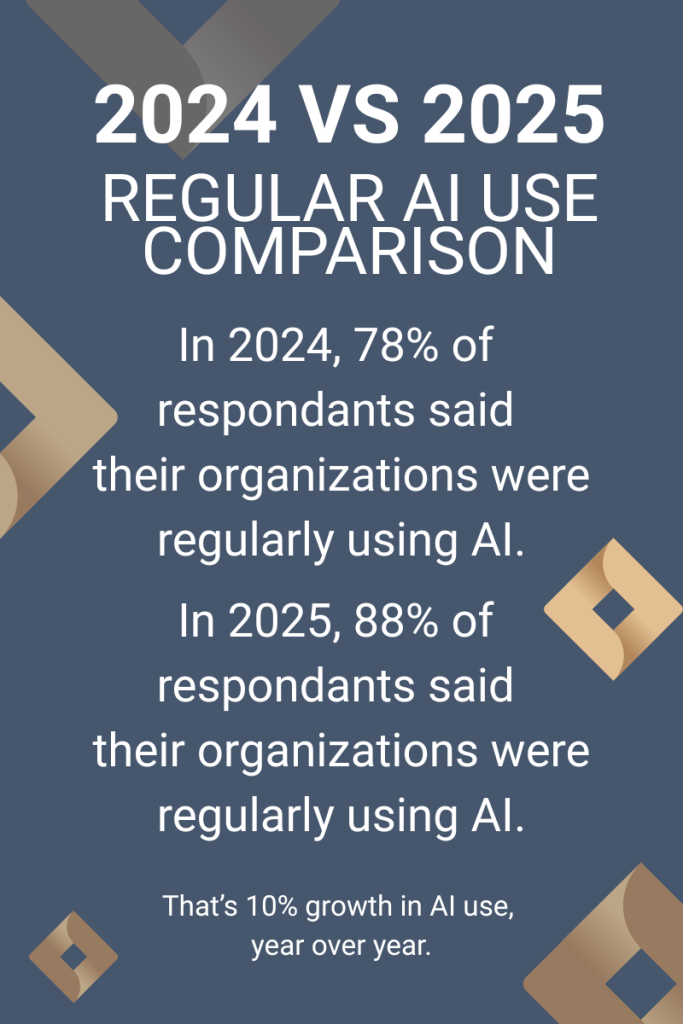
Comparison of 2024 and 2025 and the regular use of AI in organizations, in 2024 it was 78% of organizations that responded to a survey, in 2025 it went up to 88%. A forward deployed engineer will be essential for any of these companies and their AI initiatives.

But McKinsey also reported that nearly two-thirds of organizations have not yet begun scaling AI to an enterprise level, even though 62% of those respondents say their organizations are at least experimenting with AI agents. Those numbers show why we need experts like forward deployed engineers. Many companies are interested in AI, but they need people who can move projects beyond experimentation and use in a way that makes real gains for a business.

The demand for FDEs will keep growing, especially when looking at outcomes for GenAI projects. Gartner has reported that more than 50% of GenAI projects are abandoned after their proof-of-concept stages. This highlights how often organizations struggle to move AI initiatives towards production. Common failure points that Gartner noted include unclear business value, poor quality data, escalating costs, inadequate AI risk controls and AI governance concerns, and poor change management.

When Should a Company Hire a Forward Deployed Engineer?

A company should hire a forward deployed engineer when it needs hands-on technical talent to create custom product code for complex software or AI systems. In the context of AI, companies need FDEs to help move AI prototypes to stable production, build enterprise-level RAG (retrieval-augmented generation) architecture, and engineer complex agentic workflows that satisfy a company’s desire for something more like an autonomous agent.

This need is growing because companies are continuing to invest in AI while struggling to reach maturity. McKinsey’s workplace AI research found that 92% of companies plan to increase AI investments over the next three years. The problem is only 1% of leaders describe their organizations as mature in AI deployment. It will take the expertise of FDEs to remedy this problem.

A chart explaining how 92% of companies plan to boost their AI investments within the next 3 years, but the problem is that only 1% of those company leaders has reached maturity in AI deployment. Forward deployed engineers are necessary to fix this problem.

Common Hiring Triggers

Common hiring triggers include AI pilots that can’t make it to production, products with highly complex customer requirements, product teams needing feedback that’s from closer to the customer, or internal teams struggling to use new technologies in a way that directly contributes to business goals.

Signs Your AI Team Needs an FDE

Your AI team may need a forward deployed engineer if prototypes are not reaching production, users are not adopting your AI tools, data integrations are slowing progress, business teams cannot define requirements of the AI clearly, or your teams are struggling to evaluate AI outputs.

What Makes a Strong FDE Candidate?

A strong forward deployed engineer candidate has a unique hybrid skillset that bridges deep software engineering experience with a keen sense for client-facing business strategy.

In practice though, many strong FDE candidates might not even have “forward deployed engineer” in their resume. Recruiters should look for adjacent backgrounds and take a closer look at their skills, completed projects, and achievements.

The best FDE candidates should have stories to tell beyond their resume keywords. They can explain what it was they built, how they tackled constraints, what customer challenges they faced, and what they might’ve needed to do post-deployment to fix or optimize a product.

Provato Staffing recommends looking for candidates who have worked on systems that have gone live, handled post-deployment issues, worked across teams, led client-facing technical discussions, displayed good customer handling, and improved products based on user or customer feedback.

A forward deployed engineer knows how to communicate with customers, stakeholders, and technical teams, translating for each of them to maintain alignment on projects.
Many companies are interested in AI, but they need FDEs who can move projects beyond experimentation, translate between the customer and the developers, and enable AI projects to make real gains for a business.

Resume Keywords Recruiters Should Search For

These resume keywords are useful for recruiters in finding forward deployed engineers, especially accounting for how their hybrid nature touches the different roles mentioned here:

  • Forward deployed engineer
  • Forward deployed AI engineer
  • Solutions engineer
  • Customer engineer
  • Technical solutions engineer
  • Implementation engineer
  • Applied AI engineer
  • AI engineer
  • Platform engineer
  • Technical consultant
  • Enterprise implementation
  • Systems integration
  • API integration
  • RAG
  • LLM
  • GenAI
  • MLOps
  • AI agents
  • Workflow automation
  • Production deployment

Interview Questions to Ask FDE Candidates

When interviewing candidates for an FDE role, you should try to ask good probing questions to test for their hybrid nature such as the candidate’s comfort with chaos, how well they hold the line while maintaining client diplomacy, working under pressure, and their aptitude for discovering trends amongst customers.

Questions around a candidate’s comfort with chaos may include working with poorly defined customer problems or requirements, dealing with vague requests, and HOW did the candidate resolve this.

When asking about a candidate’s ability to maintain diplomacy, ask about how they handled demanding customers, how did they push back to keep a project within scope and on time, and look out for red flags.

Working under pressure is particularly great for FDEs as they are relied upon to help fix live deployment issues that can be costly for any company. Ask the candidate to give you a walkthrough of how they worked under this kind of pressure and ask them to give you the step-by-step explanation.

Skilled FDEs will also be able to notice trends happening amongst projects, like maybe several customers complaining about integration issues. This increased perception enables them to develop solutions that can make deployments more efficient or reliable and products.

How an IT Staffing Agency Can Help with Recruiting FDEs

A staffing agency that specializes in IT and engineering can help employers define this hybrid role clearly, determine adjacent talent, and screen for both engineering ability and customer-focused communication skills.

This is especially valuable because of how the FDE role is still emerging and taking shape. Many companies are still finding different ways that an FDE can help them.

For AI-related hiring, staffing agencies can also help evaluate whether candidates have real production experience or only prototype-level exposure. That difference matters as more organizations invest in AI but are struggling to scale it. The right staffing partner can help organizations and their hiring managers separate candidates who have experimented with AI from candidates who have deployed technical systems that users rely on.

A specialized IT recruiter like Provato Staffing can help clarify whether your organization needs a forward deployed engineer, solutions architect, AI engineer, implementation engineer, or a blended profile.


Guide to Passive Candidate Sourcing in IT-Engineering

Many companies understand that passive candidate sourcing can be highly valuable in IT and engineering hiring. But the harder question is how to actually find and engage them. According to a 2026 review by National University, 46% of employers say, “attracting qualified candidates is their #1 challenge” and that also 52% of employees “are open to leaving their current role in 2026”. This suggests that a substantial share of employed talent across the country, including people in IT and engineering fields, might be open to a new role if given the right opportunity. But these numbers also suggest that companies are struggling right now to tap into this large source of passive talent.

Internal HR teams aren’t always equipped with the resources to start and nurture their own pipeline of passive candidates. This process takes time, effort, and a familiarity with the process to ensure the sourced talent remains engaged and successfully attracted to a new role.

That’s when an IT recruiter like Provato Staffing can provide expertise, guidance, and an already-established passive talent network that can seek out the skilled tech workers that your organization requires to fill your open roles.

Sourcing passive candidates requires more than just searching for a job title and sending a generic message to a currently-employed individual. IT-engineering recruiters need to understand the required skills, identify any adjacent titles, evaluate technical signals, choose the right sourcing channels, and track talented workers, and be able to repeat the process while nurturing any sourced talent.

This deep-dive guide of proven strategies will break down how to source passive candidates for IT and engineering positions, from knowing where to look and build your search criteria to knowing when an IT staffing partner can help expand your reach and quicken your passive recruitment.

Before you begin your search and find your first passive candidate, you need to know exactly what candidate qualities to look for.

What Is Passive Candidate Sourcing?

Passive candidate sourcing is the process of proactively identifying and engaging potential talent who are not actively applying to jobs but may be open to the right role should the opportunity arise.

In IT and engineering recruiting, these passive candidates could be software developers, AI specialists, cloud engineers, DevOps specialists, cybersecurity professionals, data engineers, systems administrators, electrical engineers, mechanical engineers, and other roles. But what makes them “passive” is that they are currently employed and may not be actively searching for their next job opportunity.

This means these talented individuals may not be on job boards where they’d be easier to find. Instead they may be happy in their current role, but they could still be open to a position if offered stronger compensation, better flexibility, more benefits, more technical ownership, clear career growth, or even just a more interesting project environment.

Definitions for Terms Often Found in Passive Candidate Sourcing

TermMeaning
Passive CandidateThese are candidates who are not actively applying but may consider the right role if approached the right way
Passive Candidate SourcingThis is the PROCESS of finding and engaging with already-employed individuals
Passive Talent PipelineThis is the proactively sourced and nurtured collection of qualified passive candidates that can be for current or future hiring needs

If you’d like, you can learn more here at Provato Staffing about what a passive candidate is and how they can bring you the best in IT and engineering talent.

The next step will be to understand how passive candidate sourcing actually works in a technical recruiting environment.

How Does Passive Candidate Sourcing Work in IT-Engineering Recruiting?

Passive candidate sourcing in IT-engineering recruiting works by having your recruiters analyze the role requirements and transform them into practical search criteria. This helps you pick out potentially qualified talent across multiple channels, determine a person’s technical fit, and engage those passive candidates with relevant, hyper-personalized outreach.

But before searching for your passive candidates, you will need to clearly establish:

  • What the candidate’s required skills are
  • What kind of seniority level they need to have (entry, mid-level manager, etc.)
  • What kinds of tools they should have expertise in
  • What platform experience they need
  • What the expected compensation range should be
  • Work location or work model preference
  • What your hiring timeline is to keep track

From there, your recruiting team can begin the process of passive candidate sourcing. But the process isn’t easy and requires a lot of effort, and there are challenges to be aware of.

What Are the Challenges in Passive Candidate Sourcing?

Passive candidate sourcing comes with challenges that require IT and engineering recruiters to depend on more than just keyword matching. Recruiters need to understand how different titles, skills, and experiences can connect to each other to create a professional who can complete your intended job role.

For example, say that your company is looking to hire a cloud engineer, or at least that’s your initial thought. But depending on the actual responsibilities, you might be able to consider DevOps engineer candidates, or other relevant talent.

The same applies to engineering roles. A manufacturing company hiring an electrical engineer may need someone with experience in PLC programming or controls systems. But that means they may want to also look at controls systems engineers, automation engineers, or even mechanical engineers in some cases.

The point is, the right candidate may not use the exact job title in the posting, but their experience and skills may be close enough that it should count in meeting the role’s goals and expectations!

With the above passive candidate sourcing workflow in mind, the next section breaks down this process into practical steps for tech recruiters to follow.

Depending on the actual responsibilities of a role, sometimes a passive candidate with a different job title may still fit.

How to Source Passive Candidates Step-By-Step

This step-by-step process to sourcing passive candidates will guide you on how to prepare for your search, how to conduct your candidate sourcing, and how to track your results and nurture the candidates you do find.

With a step-by-step process, your recruiters will stay focused, be able to evaluate talented individuals more consistently, and avoid wasting time on profiles that are unlikely to fit the role’s requirements.

The Step-By-Step Process for Sourcing Passive Candidates

StepActionTech Recruiting Example
1Clarify the roleConfirm what your candidate’s tech stack, seniority, work model, salary range, and must-have skills should be.
2Build a candidate personaIdentify likely and adjacent titles, industries, tools, skills, technical environments, and career paths.
3Create search criteriaSeparate required skills from preferred qualifications, what a candidate MUST HAVE versus what can be taught on the job.
4Choose sourcing channelsUse LinkedIn, GitHub, Kaggle, Stack Overflow, and other niche platforms and communities.
5Review technical signalsLook for a candidate’s past projects, their education and certifications earned, platform experience, and recent tool usage.
6Prioritize candidatesRank your discovered candidates by technical fit, geography and/or work location preference, seniority, and relevance to your open role.
7Send targeted outreachUse a brief but hyper-personalized message that’s tied to the candidate’s experiences, background, and their work.
8Follow up appropriatelyUse a respectful keep-warm cadence, but don’t overwhelm the candidate
9Track resultsFollow and measure response rate, positive replies, qualified screens, and if any candidates apply.
10Add future-fit candidates to the pipelineSegment candidates by skill set, role type, and timing. Continue to nurture those candidates to maintain the talent pipeline.

Before anything else can be done, the first step must be done right.

If the role intake is unclear, every sourcing decision after it becomes weaker. Recruiters need to know which requirements are non-negotiable and which ones can flex for the right candidate.

How Must-Have and Nice-to-Have Job Requirements Impact Your Passive Candidate Sourcing

Expanding the IT Passive Candidate Sourcing

For example, an IT hiring manager may list Kubernetes, Terraform, AWS, Python, and CI/CD as requirements. But after some looking over, an IT recruiter may learn that while Kubernetes and CI/CD are essential, Python is more of a nice-to-have for the role they have in mind. That distinction can significantly expand the number of qualified passive candidates sourced.

Expanding the Engineering Passive Candidate Sourcing

This same issue appears in engineering candidate searches. A job description may mention both AutoCAD and SolidWorks as requirements, but the hiring manager may only require one of those platforms if the potential employee has strong product design or manufacturing experience, or they may consider someone with CATIA experience instead. By including CATIA in the search criteria, again the qualified passive talent to be sourced increases.

After sourcing process is properly defined, recruiters need to turn the role requirements into clear search criteria.

Only with careful determination of your passive candidate search criteria can you find as close a match as possible.

What Are the Best Sourcing Techniques for Passive Candidate?

The best passive candidate sourcing techniques used by recruiters include expanding to adjacent titles, talent mapping, targeted niche community sourcing, hyper-personalized outreach, employee referrals, and talent pipelines.

What makes adjacent titles stand out is how it expands your recruitment net, allowing you to potentially find candidates with the right skills and knowledge, but just under a different job title.

Talent mapping is a proactive recruiting strategy that uses a mix of internal gap analysis, market availability analysis, and long-term talent pipeline building. This is all done in advance of any vacancies popping up, so that you can better track industry talent trends and pick out passive candidates accordingly.

Target niche community sourcing is about going beyond the job board and exploring technical or specialized professional communities like GitHub and Stack Overflow. There are many professional communities to source passive candidates based on their offered knowledge, how they assist each other in public projects, and other forms of showing off expertise.

Hyper-personalized outreach is the act of communicating with potential passive candidates and engaging with them with value instead of job requirements. This means approaching the candidate and speaking about a skill they have or a project they did that you found impressive.

Employee referrals are useful so long as they are very specific. Make sure you specify about the kind of passive candidate you’re looking for. For example, you might ask your employees about “Do you know of anyone with experience in Kubernetes and Docker, and is familiar with cloud platforms?” or “Who is the best mechanical engineer that you know? It’s okay if they have electrical engineer experience, we can work with that.”

Talent pipelines are where passive candidates are added and nurtured to maintain a ready group that could potentially fill new roles. Once a candidate has been successfully engaged during outreach, they can be added to the passive talent pipeline and be nurtured on a regular basis to maintain a connection. This is to encourage trust with your organization before a new role appears.

What Communities Can Tech Recruiters Source Passive Candidates?

As lightly discussed above about niche technical communities, tech recruiters can find passive candidates in online communities such as LinkedIn, GitHub, Dev.to, Stack Overflow, and Hashnode. Each community offers different views into potential talent, such as how LinkedIn may be best for seeing a candidate’s professional history, but Stack Overflow is better for seeing how someone solves a complex problem and collaborates with others.

Here are examples of those online communities that recruiters in IT and engineering often visit:

  • LinkedIn
  • GitHub
  • Stack Overflow
  • GitLab
  • Bitbucket
  • Dev.to
  • Hashnode
  • Kaggle
  • daily.dev

Finding likely candidates is only part of the process. Before trying to contact them, recruiters need to evaluate whether the potential talent is going to be truly relevant to the role and that involves analyzing a potential worker’s technical signals.

Before performing outreach, be sure you investigate potential passive candidates for their technical signals such as their fit based on past work environments.

What Comes After Sourcing Passive Candidates?

Passive candidate sourcing is an exhaustive process, especially if you want it to maintain it as a repeatable passive talent pipeline. But not all organizations have those resources, and many don’t have the time. Also, if your internal HR is unfamiliar with how to perform the proper outreach and nurturing of targeted talent, all your sourcing efforts may fall apart and amount to nothing.

That’s when you may need help developing a technical talent pipeline with an IT-engineering staffing partner.

Once you've defined your passive candidate personas and search criteria, you can begin segmenting the passive candidates you source.

When Should You Use an IT Staffing Partner for Passive Candidate Sourcing?

Your company should consider using an IT staffing partner for passive candidate sourcing when your open roles are specialized, your internal recruiters lack the necessary bandwidth and resources, inbound applicants are weak, the search is confidential, or your hiring timeline is urgent.

Another good time to consider an IT staffing partner is if your organization’s internal HR does not have an established proactive recruiting strategy in place. IT recruiters already have a passive talent pipeline for you to take advantage of.

IT staffing recruiters like Provato Staffing speed up your hiring process by already performing the technical screening and vetting. When you work with these IT recruitment partners, they’ll work with you to understand your ideal candidate (much like defining personas in the section above) and will then quickly produce a shortlist of potential employees for you to choose from for your interviews.

What is the ROI of Passive Candidate Sourcing with an IT Staffing Partner?

The ROI of passive candidate sourcing with an IT staffing partner includes reducing your time-to-fill by filling your specialized roles by 25-40% faster by opening the doors for you to as much as 70% of the passive market that can’t be found through public job boards. This grants you an edge in both speed and reach, which is crucial in competitive tech markets.

What’s more, you can lower overall cost-per-hire and save up to tens of thousands of dollars by avoiding bad hires that would cost additional time and money while you search for a better candidate.

Ready to Find Hidden IT and Engineering Talent?

Provato Staffing is more than just a staffing agency. We’re a recruiting partner with a specialized background in IT and engineering. Whether you’re looking for an AI/ML specialist, a mechanical engineer, cloud engineer, critical facilities engineer, or other hard-to-find tech talent, we’ll work with you to clarify your role(s), find qualified talent, and provide you with a shortlist of high-quality candidates. We can also provide market intelligence, the latest in compensation trend data, and more, all at your fingertips.

Instead of depending on inbound applications that don’t fit, Provato can save you time and effort by tapping into our passive talent pipeline, and finding shortlisted candidates aligned with your technical requirements, hiring model, and hiring schedule.