
The Forward Deployed Engineer: A Recruiting Guide


What Is a Forward Deployed Engineer?
A forward deployed engineer (FDE) is a customer-facing technical professional who works closely with customers, business teams, or deployment sites. This doesn’t necessarily mean the person is always physically on-site, but it does mean they will be working directly with stakeholders, customers and users, and internal teams.
Their tasks include building, deploying, and improving complex software systems in real-world environments. In the world of AI, FDEs are counted on to get a proof of concept from the AI pilot stage to production.
Many companies are in the process of trying to adopt AI. But after they build a proof of concept or test their new generative AI tool, they struggle to move from pilot to production. Forward deployed engineers can be seen as truly multi-talented specialists as they must go beyond coding and debugging and have to act as a master of communication between multiple parties.

What Does a Forward Deployed Engineer Do?
A forward deployed engineer main responsibilities include:
- Designing Systems
- Writing Production-Quality Code
- Integrating APIs and Data Pipelines
- Configuring Cloud Environments
- Helping teams adopt new software or AI workflows
- Debugging Post-Deployment Issues
After deployment, the FDE is still responsible for performing any live fixes and ensuring the system remains stable. This involves a process of incident response and triage and performance tuning before transitioning to a technical handoff where they train client engineers and create troubleshooting documents for the customer to use.
Even after they’ve fully handed off the system to the client, the FDE needs to abstract any useful custom integrations and other components from the product that can be made into reusable templates or internal SDKs. This part helps make the next similar project go faster.
You can see how FDEs are very hybrid in nature. Recruiting conversations may even make FDEs sound like three roles at once. If there was a Venn diagram of a software engineer, solutions architect, and an implementation lead, the forward deployed engineer is right in the middle of all three.
Why Forward Deployed Engineers Matter in AI
Forward deployed engineers matter in AI because many AI projects fail when they reach deployment and production. A model or platform may look impressive in a demo, but many organizations end up with a new AI system struggling to integrate with messy enterprise data, legacy systems, complex compliance requirements, and entrenched user workflows.
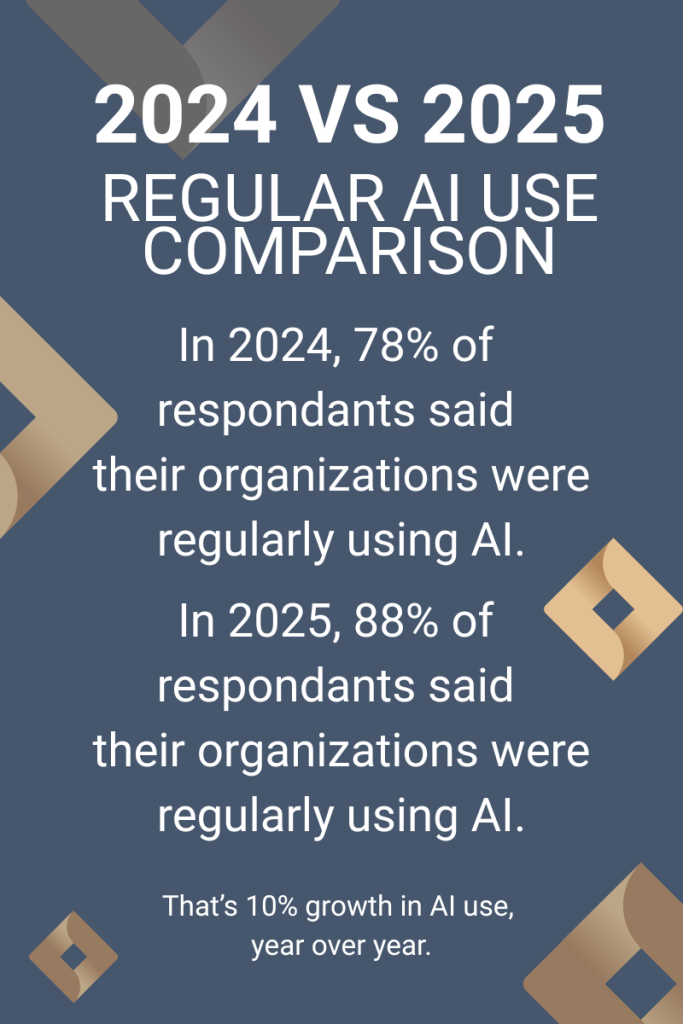
AI adoption is already widespread with McKinsey’s 2025 global AI survey finding that 88% of respondents’ organizations reported regular AI use in at least one business function. That’s a significant increase from 78% the year before.
But McKinsey also reported that nearly two-thirds of organizations have not yet begun scaling AI to an enterprise level, even though 62% of those respondents say their organizations are at least experimenting with AI agents. Those numbers show why we need experts like forward deployed engineers. Many companies are interested in AI, but they need people who can move projects beyond experimentation and use in a way that makes real gains for a business.
The demand for FDEs will keep growing, especially when looking at outcomes for GenAI projects. Gartner has reported that more than 50% of GenAI projects are abandoned after their proof-of-concept stages. This highlights how often organizations struggle to move AI initiatives towards production. Common failure points that Gartner noted include unclear business value, poor quality data, escalating costs, inadequate AI risk controls and AI governance concerns, and poor change management.
When Should a Company Hire a Forward Deployed Engineer?
A company should hire a forward deployed engineer when it needs hands-on technical talent to create custom product code for complex software or AI systems. In the context of AI, companies need FDEs to help move AI prototypes to stable production, build enterprise-level RAG (retrieval-augmented generation) architecture, and engineer complex agentic workflows that satisfy a company’s desire for something more like an autonomous agent.
This need is growing because companies are continuing to invest in AI while struggling to reach maturity. McKinsey’s workplace AI research found that 92% of companies plan to increase AI investments over the next three years. The problem is only 1% of leaders describe their organizations as mature in AI deployment. It will take the expertise of FDEs to remedy this problem.

Common Hiring Triggers
Common hiring triggers include AI pilots that can’t make it to production, products with highly complex customer requirements, product teams needing feedback that’s from closer to the customer, or internal teams struggling to use new technologies in a way that directly contributes to business goals.
Signs Your AI Team Needs an FDE
Your AI team may need a forward deployed engineer if prototypes are not reaching production, users are not adopting your AI tools, data integrations are slowing progress, business teams cannot define requirements of the AI clearly, or your teams are struggling to evaluate AI outputs.
What Makes a Strong FDE Candidate?
A strong forward deployed engineer candidate has a unique hybrid skillset that bridges deep software engineering experience with a keen sense for client-facing business strategy.
In practice though, many strong FDE candidates might not even have “forward deployed engineer” in their resume. Recruiters should look for adjacent backgrounds and take a closer look at their skills, completed projects, and achievements.
The best FDE candidates should have stories to tell beyond their resume keywords. They can explain what it was they built, how they tackled constraints, what customer challenges they faced, and what they might’ve needed to do post-deployment to fix or optimize a product.
Provato Staffing recommends looking for candidates who have worked on systems that have gone live, handled post-deployment issues, worked across teams, led client-facing technical discussions, displayed good customer handling, and improved products based on user or customer feedback.

Resume Keywords Recruiters Should Search For
These resume keywords are useful for recruiters in finding forward deployed engineers, especially accounting for how their hybrid nature touches the different roles mentioned here:
- Forward deployed engineer
- Forward deployed AI engineer
- Solutions engineer
- Customer engineer
- Technical solutions engineer
- Implementation engineer
- Applied AI engineer
- AI engineer
- Platform engineer
- Technical consultant
- Enterprise implementation
- Systems integration
- API integration
- RAG
- LLM
- GenAI
- MLOps
- AI agents
- Workflow automation
- Production deployment
Interview Questions to Ask FDE Candidates
When interviewing candidates for an FDE role, you should try to ask good probing questions to test for their hybrid nature such as the candidate’s comfort with chaos, how well they hold the line while maintaining client diplomacy, working under pressure, and their aptitude for discovering trends amongst customers.
Questions around a candidate’s comfort with chaos may include working with poorly defined customer problems or requirements, dealing with vague requests, and HOW did the candidate resolve this.
When asking about a candidate’s ability to maintain diplomacy, ask about how they handled demanding customers, how did they push back to keep a project within scope and on time, and look out for red flags.
Working under pressure is particularly great for FDEs as they are relied upon to help fix live deployment issues that can be costly for any company. Ask the candidate to give you a walkthrough of how they worked under this kind of pressure and ask them to give you the step-by-step explanation.
Skilled FDEs will also be able to notice trends happening amongst projects, like maybe several customers complaining about integration issues. This increased perception enables them to develop solutions that can make deployments more efficient or reliable and products.
How an IT Staffing Agency Can Help with Recruiting FDEs
A staffing agency that specializes in IT and engineering can help employers define this hybrid role clearly, determine adjacent talent, and screen for both engineering ability and customer-focused communication skills.
This is especially valuable because of how the FDE role is still emerging and taking shape. Many companies are still finding different ways that an FDE can help them.
For AI-related hiring, staffing agencies can also help evaluate whether candidates have real production experience or only prototype-level exposure. That difference matters as more organizations invest in AI but are struggling to scale it. The right staffing partner can help organizations and their hiring managers separate candidates who have experimented with AI from candidates who have deployed technical systems that users rely on.
A specialized IT recruiter like Provato Staffing can help clarify whether your organization needs a forward deployed engineer, solutions architect, AI engineer, implementation engineer, or a blended profile.